Let's cut through the noise. Here's what you actually need to know.
What Is Autism Therapy and How Does It Help My Child?
Autism therapy isn't one thing. It's a set of evidence-based approaches that help kids with autism spectrum disorder (ASD) build skills.
Think communication. Social interaction. Motor coordination. Emotional regulation. Daily living skills like dressing and eating.
Your child's brain is wired differently. That's not a flaw. Therapy helps them build skills for a world that wasn't built for their wiring.
The CDC's ADDM Network reported in 2025 that about 1 in 31 eight-year-olds in the United States had been identified with autism in 2022. In Canada, the Public Health Agency of Canada reported in 2022 that 1 in 50 children and youth aged 1 to 17 had an autism diagnosis.
Early support matters. In one follow-up study, gains from an intensive intervention started before 30 months of age were maintained two years later, at age 6 (Estes et al., 2015).
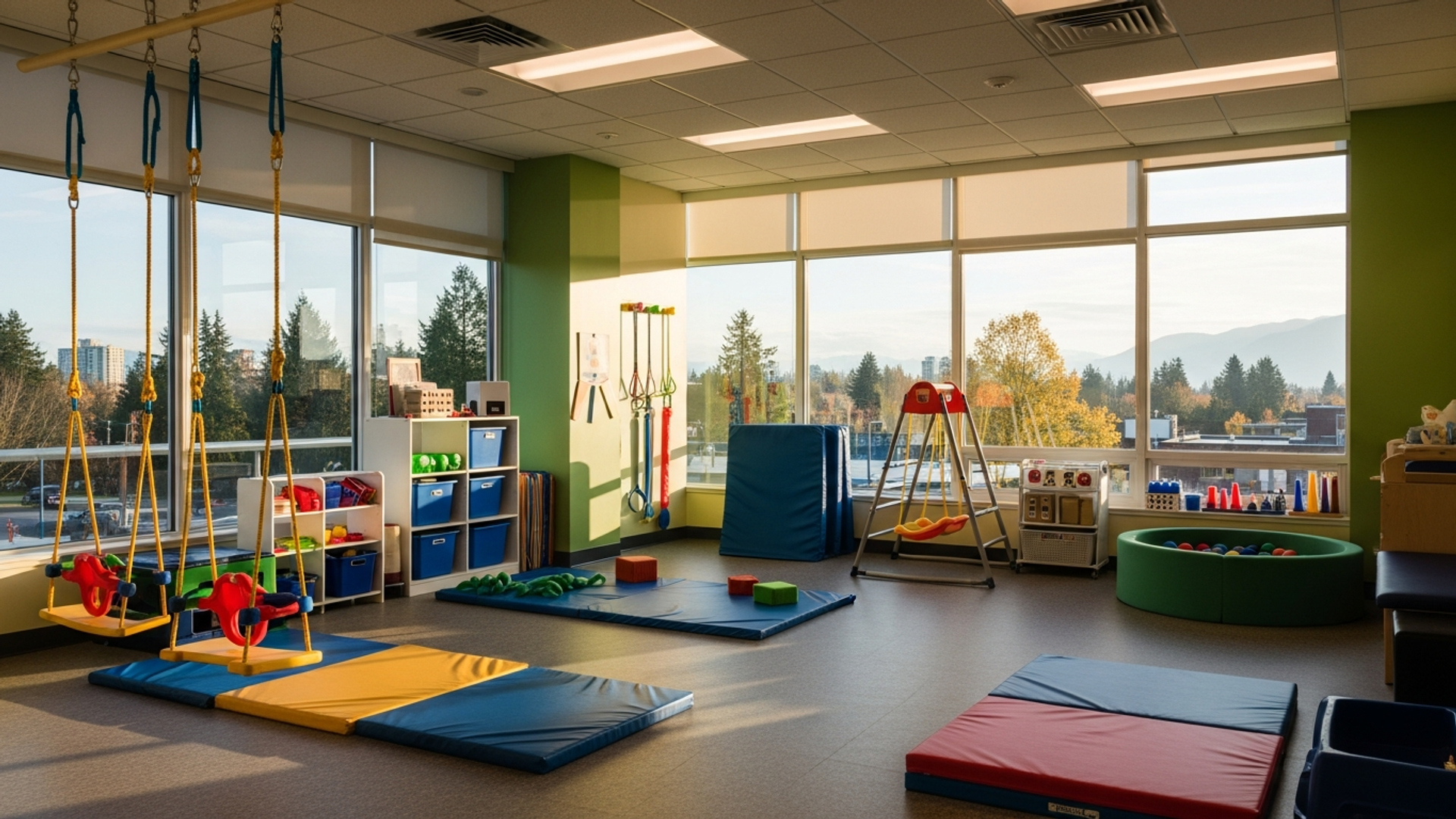
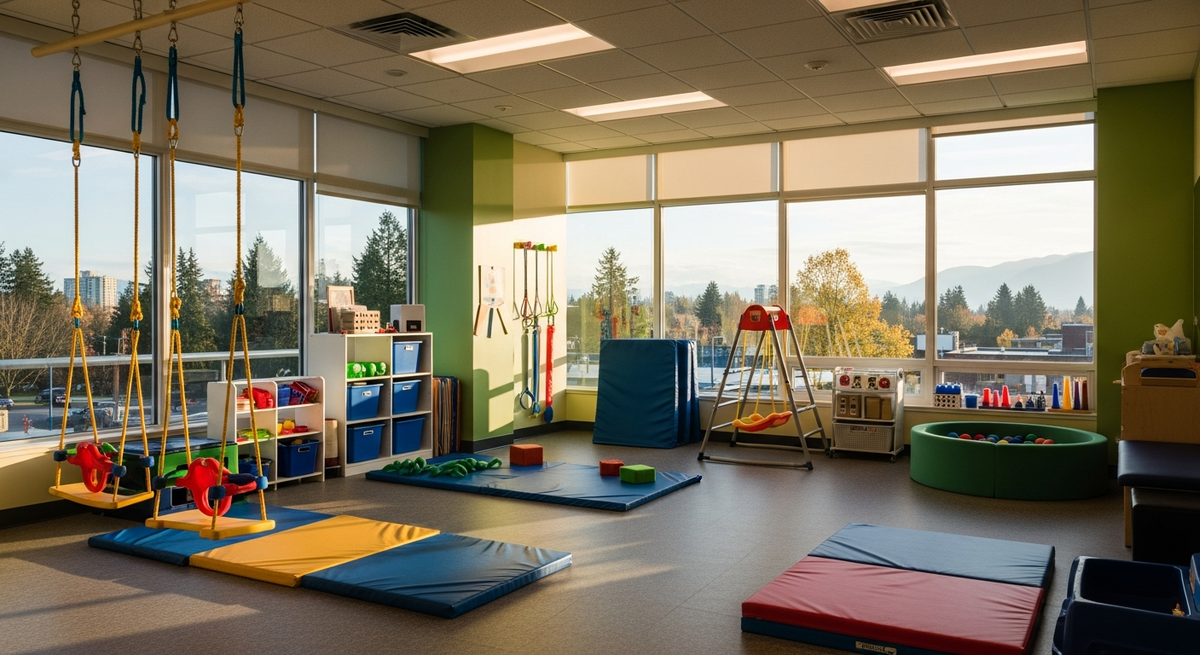
At KidStart, therapists can use the on-site sensory gym when it fits a child's goals.
What Types of Autism Therapy Are Available Near Me?
You have options. Here's what works.
Occupational Therapy (OT)
Occupational therapy focuses on everyday skills. For kids with autism, that means:
- Sensory processing (handling loud noises, tags, textures)
- Fine motor skills (holding a pencil, using scissors)
- Self-care (dressing, brushing teeth, toileting)
- Coordination and body awareness
Our occupational therapy services use the sensory gym. The equipment is used when it fits your child's goals.
Speech-Language Therapy
Many kids with autism struggle with communication. Some don't speak. Others speak but don't know how to start a conversation.
Speech therapy helps with:
- Verbal and nonverbal communication
- Social pragmatics (turn-taking, eye contact, reading cues)
- Augmentative and alternative communication (AAC) devices
- Feeding and swallowing issues
Behavioral Therapy
Behavioural therapy focuses on reducing challenging behaviours and building new skills. Many programs teach skills in everyday situations, an approach called naturalistic developmental behavioural intervention (NDBI).
Our behavioral therapy program works on skills like following instructions, waiting, and transitioning between activities.
TILP Program
At KidStart, TILP stands for Therapeutic Intensive Learning Program. It combines occupational therapy, speech therapy and BCBA-supervised behavioural consultation for about 10.5 hours a week, for children ages 3 to 6.
Your child gets one integrated plan instead of three separate ones.
How Do I Know Which Type of Autism Therapy My Child Needs?
You don't have to figure this out alone.
Start with an assessment. A registered occupational therapist or speech-language pathologist evaluates your child. They look at strengths and challenges. They talk to you about what matters most to your family.
Maybe your child melts down at the grocery store because the lights are too bright. That's sensory — OT can help.
Maybe your child wants to play with peers but doesn't know how to ask. That's social communication — speech therapy can help.
Maybe your child hits when frustrated because they can't express anger any other way. That's behavior — behavioral therapy can help.
Many kids need more than one type. That's okay. We coordinate.
Does BC Autism Funding Cover Autism Therapy Near Me?
Yes. British Columbia offers autism funding for families with children diagnosed with ASD.
The Ministry of Children and Family Development (MCFD) provides funding through Autism Funding: a set annual amount per child. This funding can be used for eligible therapy services, including OT, speech therapy, and behavioral therapy.
Children under 6 can receive up to $22,000 per year.
Children aged 6 to 18 can receive up to $6,000 per year. The program ends on March 31, 2027, when a needs-based BC Children and Youth Disability Benefit begins.
KidStart's autism funding page says it accepts BC government funding.
Visit our autism funding page for details on how to apply and what's covered.
How Long Does Autism Therapy Take to Show Results?
Every child is different. But research gives us a general picture.
Intensity varies. A 2012 Cochrane review described early intensive behavioural intervention as 20 to 40 hours a week over several years, but many families start with fewer hours. Ask your team what fits your child.
Some changes show up sooner than others, so ask how progress will be tracked against your child's own goals.
Bigger changes — like initiating conversation or independent toileting — take months to years.
Progress isn't linear. Kids have good weeks and bad weeks. That's normal.
What Should I Look for When Choosing an Autism Therapy Provider?
Not all providers are created equal. Here's what matters.
Qualified therapists. Look for registered occupational therapists (OT), speech-language pathologists (SLP), or board-certified behavior analysts (BCBA). In BC, OTs and SLPs must be registered with the College of Health and Care Professionals of BC.
Evidence-based methods. Ask if they use approaches backed by research. For autism, that includes naturalistic developmental behavioral interventions (NDBI) and applied behavior analysis (ABA).
Play-based approach. Kids learn best through play. If a clinic looks like a hospital, keep looking.
Parent involvement. The best therapy includes parent coaching. You're with your child more than any therapist. You need tools to use at home.
Accepts BC Autism Funding. Ask how the clinic handles billing.
Location and hours. Burnaby, Coquitlam, and Greater Vancouver families should find a clinic they can reach without a long drive.
How Do I Get Started with Autism Therapy Near Me?
Step 1: Get a diagnosis. If your child doesn't have an autism diagnosis, start with your family doctor or pediatrician. In BC, a diagnosis is made by a pediatrician, psychiatrist or registered psychologist, through the BC Autism Assessment Network or privately.
Public wait times can be long, and some families choose a private assessment.
Step 2: Apply for BC Autism Funding. For both children under 6 and ages 6 to 18, you apply through the Ministry of Children and Family Development (MCFD).
Step 3: Call us. We'll schedule an intake assessment. We meet you and your child. We observe, play, and talk with you.
Step 4: We create a plan. You get a written report with goals and recommendations. We discuss frequency and type of therapy.
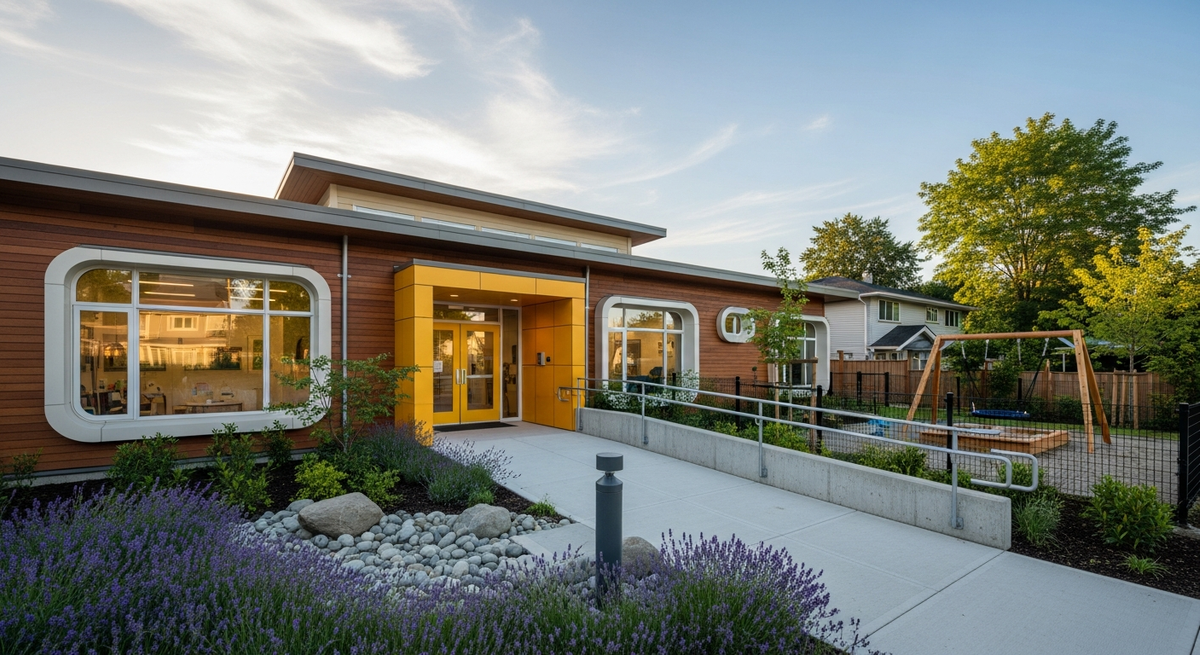
Step 5: Start therapy. Your child comes to our clinic in Burnaby. We work with them in our sensory gym, therapy rooms, and play spaces.
What Makes KidStart Pediatric Therapy Different?
KidStart's team includes occupational therapists, speech-language pathologists, behaviour consultants and interventionists led by a Board Certified Behavior Analyst, and a registered clinical counsellor.
The on-site sensory gym is used when it fits a child's therapy goals.
In TILP, occupational therapy, speech therapy and behavioural consultation are coordinated, so you don't have to repeat the same story to three different people.
KidStart's autism funding page says it accepts BC government funding for its services.
We're located in Burnaby, serving families from Coquitlam, Port Moody, New Westminster, and Vancouver.
Can Adults Get Autism Therapy Too?
This article focuses on kids. KidStart Pediatric Therapy serves children from birth through adolescence.
If you're an adult seeking autism support, contact a clinic that specializes in adult services, or community organizations such as the Pacific Autism Family Network.
What Research Supports Autism Therapy?
Let's talk numbers.
A 2010 meta-analysis in Clinical Psychology Review found that long-term, comprehensive ABA intervention for young autistic children produced medium to large positive effects on intellectual functioning, language, daily living skills and social functioning (Virués-Ortega, 2010).
A 2012 Cochrane review of early intensive behavioural intervention found positive effects on adaptive behaviour, IQ and communication, but rated the overall quality of the evidence as low (Reichow et al., 2012).
A 2020 SPARK study found that 86.9% of autistic children aged 5 to 15 were at risk for motor impairment on a parent questionnaire, which is one reason occupational therapy and motor support matter (Bhat, 2020).
Results vary from child to child, so good programs track progress against each child's goals.
What If My Child Doesn't Have an Autism Diagnosis Yet?
You don't need a diagnosis to start therapy. Many kids benefit from OT, speech, or behavioral support while waiting for an assessment.
If you're concerned about your child's development, trust your gut. Parents are usually right.
Signs worth raising with your doctor include:
- Little or no babbling
- Not pointing to show you things
- Few or no single words
- Not putting two words together by age 2 (a CDC milestone)
- Loss of language or social skills at any age
- Avoiding eye contact
- Not responding to their name
- Lining up toys excessively
- Intense reactions to sounds, lights, or textures
If you see these signs, talk to your doctor, or call KidStart to talk through next steps. KidStart offers a free consultation.
How Much Does Autism Therapy Cost in Burnaby?
Private therapy costs vary by clinic, therapy type and session length, so ask each clinic for its current rates.
Families with an autism diagnosis can use BC Autism Funding toward eligible therapy until March 31, 2027.
Your Next Step
You've read the research. You know what works. Now it's time to act.
Contact KidStart Pediatric Therapy at kidstartpediatrictherapy.com or call 604-336-6885 to book an intake assessment. Serving Burnaby, Coquitlam, and Greater Vancouver.
Your child has potential. We help them find it.
Test Your Knowledge
1. What is the main goal of play-based therapy at KidStart Pediatric Therapy?
- A. To keep children entertained without learning
- ✅ B. To help children build skills while having fun
- C. To replace all other forms of therapy
- D. To focus only on academic skills
*The article states that play-based methods help children learn because they are having fun, and they build communication, motor, and social skills.*
2. Which of the following is NOT a type of therapy mentioned in the article?
- A. Occupational therapy
- B. Speech-language therapy
- ✅ C. Physical therapy
- D. Behavioral therapy
*The article discusses occupational therapy, speech-language therapy, and behavioral therapy, but does not mention physical therapy.*
3. What is the TILP program's unique feature?
It integrates occupational therapy, speech therapy, and behavioral therapy into one coordinated plan.
4. How much annual funding can eligible children under 6 receive through BC Autism Funding?
Up to $22,000 per year, until the program ends on March 31, 2027.