What Is the Best Footwear for Toddlers?
The best footwear for toddlers protects the foot without taking over the job of the foot.
That sounds simple. It is not always what stores sell.
A toddler foot is soft, wide, and still developing. The toes spread. The arch is still forming. The ankle is learning balance. The brain is reading pressure, texture, and movement from the floor.
For most toddlers, a good shoe has five traits:
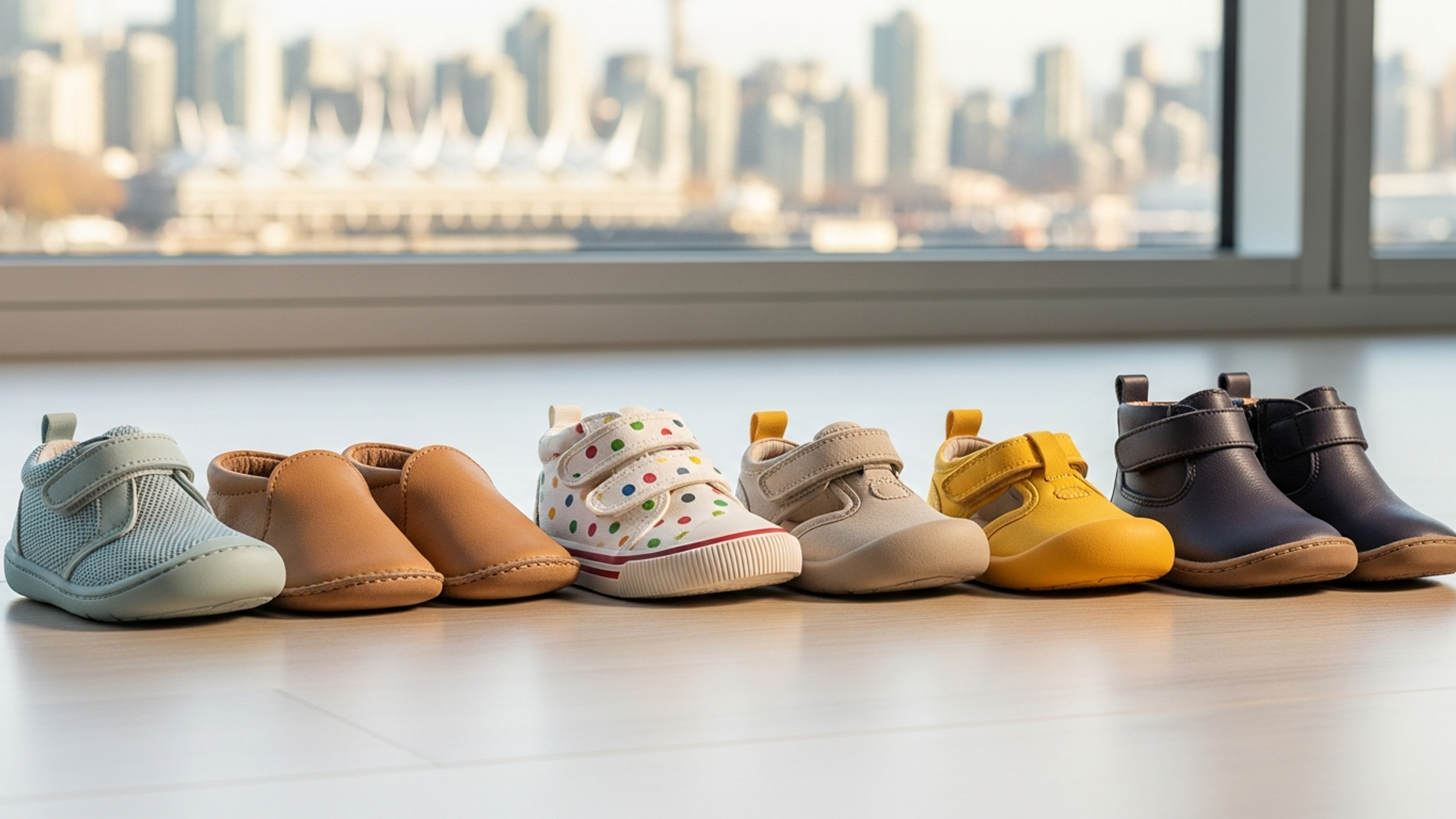
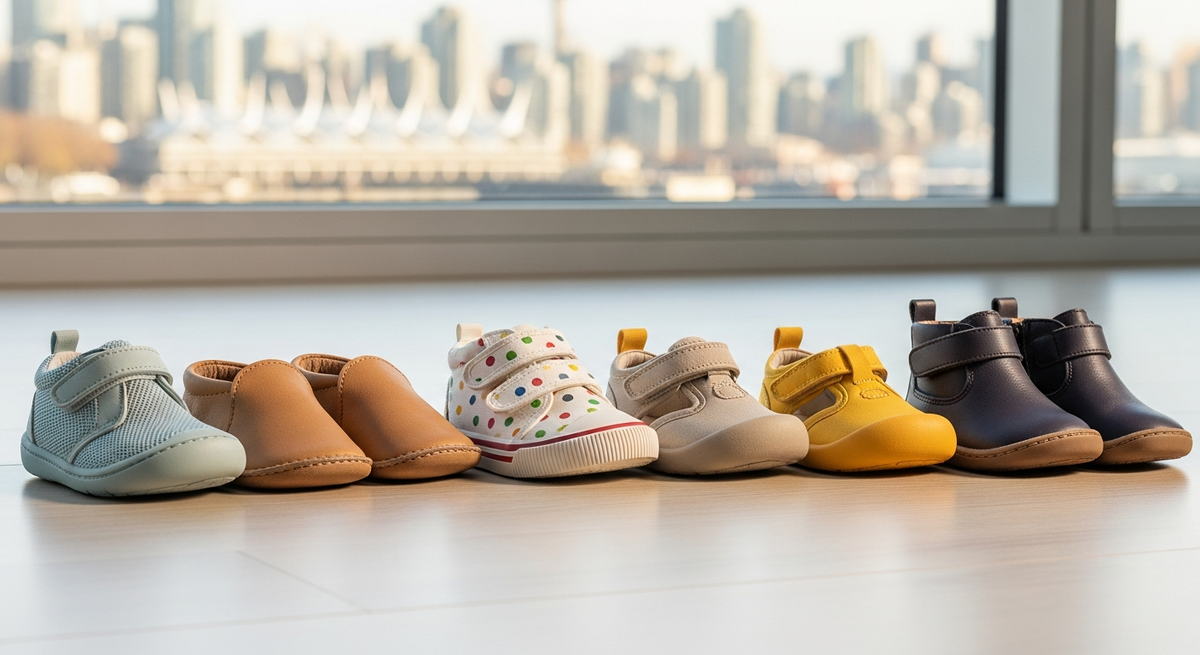
- A flexible sole that bends near the ball of the foot
- A wide toe box that lets toes spread
- A flat heel, with little or no lift
- A secure closure, such as Velcro or a strap
- A grippy sole that does not feel heavy
Research supports this function-first approach. A 2011 systematic review in the Journal of Foot and Ankle Research by Wegener and colleagues reviewed studies comparing barefoot movement with movement in shoes. The review found that shoes can change how children walk and run, including changes to step length, support time, and foot motion.
Plain English: shoes are not neutral. They can change how a child moves.
That does not mean shoes are bad. It means toddler shoes should protect without making movement harder.
For families in Burnaby, Coquitlam, and Greater Vancouver, this advice has a practical side. Toddlers move across wet sidewalks, daycare floors, playground turf, gravel paths, indoor gyms, car park pavement, and muddy parks. A good toddler shoe handles those surfaces without becoming stiff armour.
At KidStart Pediatric Therapy, our team looks at movement through play. Footwear is one small part of the whole picture. If your child trips often, toe walks, avoids shoes, or becomes very distressed during dressing, an occupational therapy lens can help. You can learn more about our pediatric therapy services at https://www.kidstartpediatrictherapy.com/services/.
When Does a Toddler Need Shoes?
A toddler needs shoes outdoors, in public places, at daycare when required, and anywhere the ground can hurt the foot.
Shoes protect against glass, sharp stones, hot pavement, wet surfaces, rough playground edges, and shared public floors. They also help meet daycare safety rules.
Indoors, barefoot time is still useful when the floor is clean and safe. Bare feet can give toddlers more direct sensory feedback from the floor. The toes can spread and grip, and the ankle can adjust as the child feels texture, pressure, slope, and balance.
That sensory input is not extra. It is part of motor learning.
For many new walkers, barefoot time on safe indoor floors may support natural movement better than stiff shoes. A child who is learning to stand and cruise needs to feel the floor. A thick sole may reduce how much ground feedback the child feels.
Here is the practical rule.
Use bare feet or thin socks at home when the surface is safe. Use flexible shoes outside, at daycare, in stores, and on shared floors.
This works for most toddlers. It also respects real parent life. You do not need a perfect setup. You need safe chances for your child to move.
If your child has a known motor delay, low tone, frequent falls, toe walking, pain, or a medical concern, ask a clinician before choosing supportive footwear, inserts, or orthotics. The right answer changes with the child.
What Should Parents Look for in Toddler Shoes?
Parents should look for fit, flex, grip, and comfort. Brand comes second.
A toddler shoe should pass a quick hands-on test before it goes on the foot.
First, bend the shoe. It should flex at the ball of the foot. It should not fold like paper in the middle. It should not stay rigid like a board.
Second, twist it gently. A little movement is good. Total collapse is not. Your child needs both ground feel and protection.
Third, press the toe box. The front should be wide and rounded. Pointed toddler shoes make no sense. Toddlers need toe spread for balance.
Fourth, check the heel. It should stay on without rubbing. A shoe that slips changes the way a child walks.
Fifth, check the closure. Velcro, hook-and-loop straps, and wide openings help. They also support independence. A toddler who can help put shoes on gets practice with dressing skills.
Good examples often come from brands such as Stride Rite, See Kai Run, Ten Little, New Balance, KEEN, and Nike Flex styles. These are not medical recommendations. They are common toddler shoe examples parents often compare. The exact model and fit matter more than the logo.
Avoid shoes that are heavy, narrow, raised at the heel, hard to bend, or slick on wet tile. Avoid backless slides for active toddlers. Avoid fashion boots for daily play.
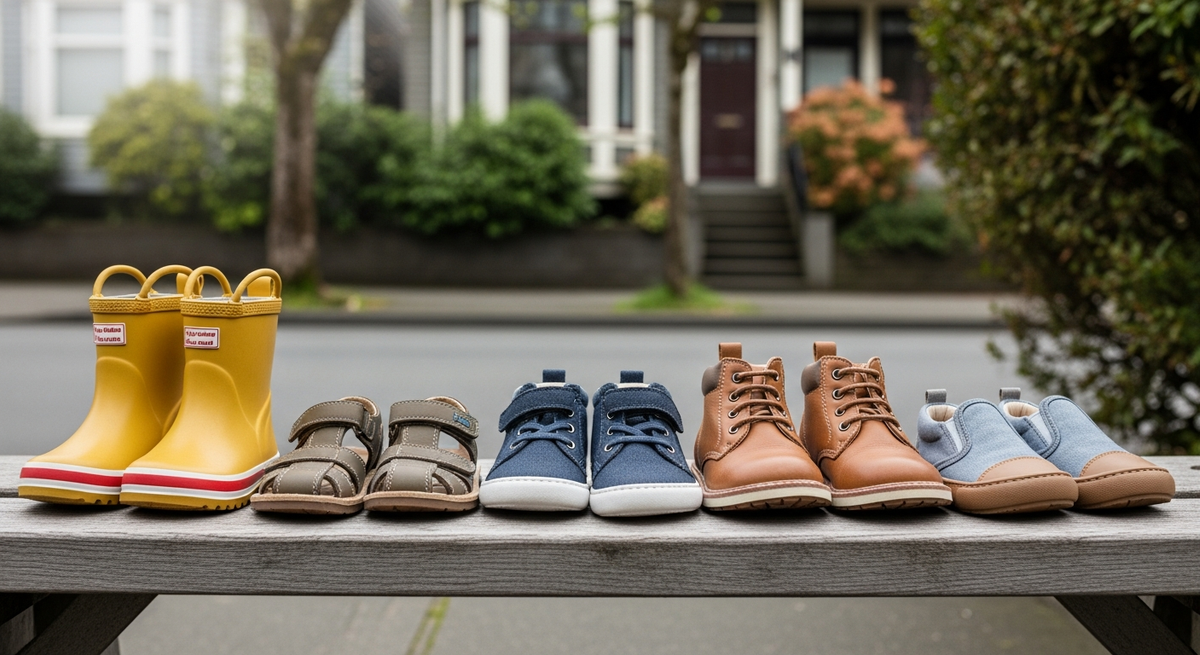
Rain boots have a place in Greater Vancouver, but many are not ideal as all-day walking shoes because they can be looser, heavier, or harder to manage on stairs and climbing equipment. Use them for puddles. Switch to a lighter shoe when play gets active.
Winter boots deserve the same test. Warm is good. Bulky is not always better. If your child starts falling more in a boot, the boot may be doing too much.
For children who need help with dressing, sensory comfort, daily routines, or motor planning, occupational therapy can connect footwear with bigger goals. KidStart explains its therapy services at https://www.kidstartpediatrictherapy.com/services/.
How Should Toddler Shoes Fit?
Toddler shoes should fit the bigger foot, leave toe room, and stay secure at the heel.
Measure both feet. Many children have one foot that is slightly larger. Buy for that foot.
Check length first. There should be a small thumb-width space in front of the longest toe. Do not guess by pressing the outside of a stiff shoe. Remove the insole if possible. Place the foot on it while the child stands.
Check width next. The toes should rest flat. They should not curl, stack, or squeeze inward. Red marks across the toes are a warning.
Check depth. Some toddlers have fuller feet. The top of the shoe should not press deep marks into the skin.
Check the heel. The heel should not lift with each step. A loose shoe can teach a child to grip with the toes or shuffle.
Check socks too. Thick socks can turn a good fit into a tight fit. Footed pajamas inside shoes can create the same problem.
Fit changes fast in toddler years. Set a monthly phone reminder to check shoes. Do it after bath time or before bedtime, when your child is calm.
Watch the walk after new shoes. A toddler should not suddenly trip, limp, drag toes, walk on the outside edge, or refuse to move. New shoes can feel strange for a day. A clear change in gait deserves attention.
Here is a simple home check:
- Stand your child on the insole if it comes out
- Check toe space while the child is standing
- Look for red marks after 20 minutes of wear
- Watch walking on flat ground
- Watch squatting, climbing, and running
- Ask older toddlers where the shoe feels tight
Toddlers do not always report pain. They adapt. That is why the parent has to inspect both the shoe and the movement.
Are Barefoot Shoes Good for Toddlers?
Barefoot-style shoes can work well for many toddlers when they fit properly, protect the foot, and match the child's movement needs.
A barefoot-style shoe usually means a wide toe box, thin flexible sole, low weight, and little heel lift. Those traits line up with what many toddlers need.
But the label is not magic. Some shoes marketed as barefoot are too thin for rough outdoor play. Some are too loose. Some wear out quickly. Some fit one child beautifully and another poorly.
Use the function test. Does the shoe protect the foot? Does it stay on? Does it bend where the foot bends? Does it leave room for toes? Does your child move naturally in it?
The 2011 Wegener review gives parents the main lesson. Shoes change how children walk. That does not make shoes bad. It means design matters.
A shoe that is light and flexible usually interferes less than a stiff shoe. A wide toe box respects balance. A flat sole keeps the child closer to the ground.
Barefoot-style shoes are not the answer for every child. Some children need more structure for a period of time. Some children use orthotics. Some children have motor patterns that need assessment.
This is where parent observation matters.
If your child runs, squats, climbs, and transitions from floor to stand with ease, a flexible shoe is often enough. If your child falls often, avoids movement, seems unstable, or has pain, do not solve it with a random shoe. Get the movement checked.
For children with autism, ADHD, sensory processing differences, or developmental delays, the shoe question can be tied to regulation. A seam in a sock can ruin the morning. A tight toe box can trigger refusal. A heavy shoe can change body awareness.
Families using BC Autism Funding can review KidStart's autism funding information at https://www.kidstartpediatrictherapy.com/autism-funding/.
Which Toddler Shoes Work Best for Daycare and Burnaby Weather?
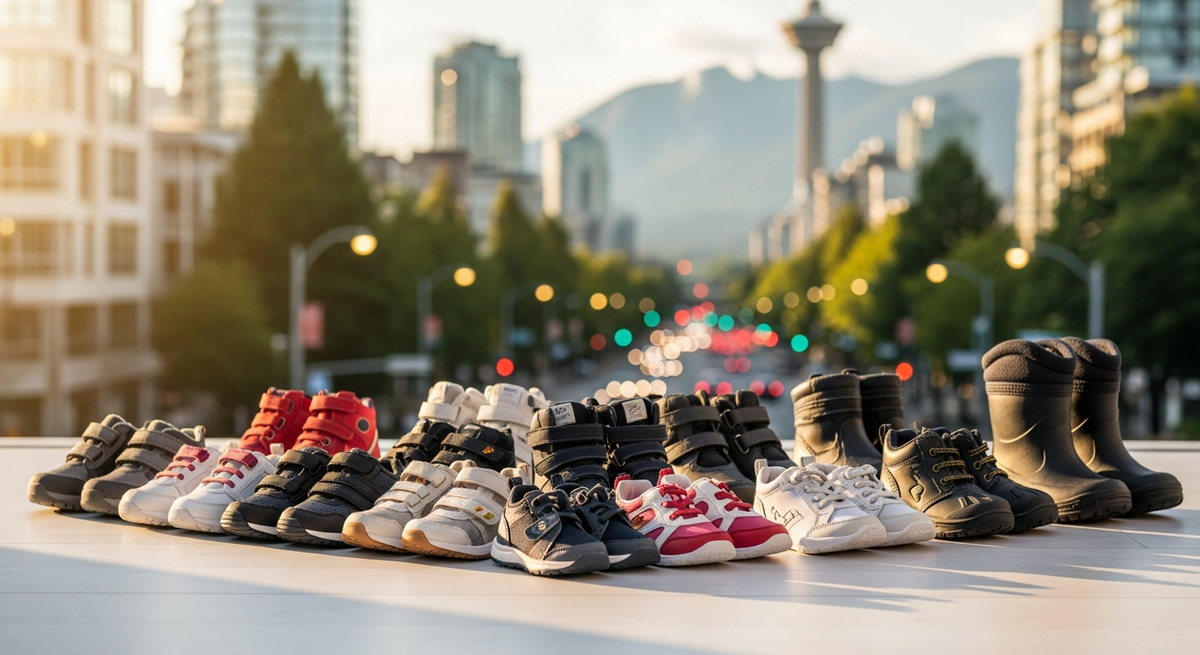
The best daycare shoes are safe, washable, easy to put on, and stable on wet surfaces.
Burnaby weather asks a lot from a toddler shoe. There is rain. There are damp playgrounds. There are slick entry mats. There are indoor gym floors. There are muddy parks near Deer Lake, Central Park, Burnaby Mountain, and Coquitlam trails.
A good daycare shoe should have:
- Non-marking grip for indoor floors
- A closed toe for playground safety
- A secure strap or Velcro closure
- Breathable fabric for long wear
- A sole that bends at the forefoot
- A shape that a tired parent can put on fast
Machine washable shoes help. So do dark colours. Daycare shoes live a hard life.
For rainy days, many families keep two pairs. One flexible sneaker for daycare and active play. One rain boot for puddles and short wet walks.
This is practical, not fancy.
Do not send a toddler for a full day in loose rain boots unless the daycare activity is mostly puddle play. Boots can make stairs, climbing, and running harder. A child who is working hard to keep boots on is not free to play.
In snow or cold rain, choose warmth without bulk. Check whether your child can squat. Check whether they can climb a low step. Check whether they can stand from the floor without using their hands too much.
Clothing and footwear are part of participation. A child cannot join circle time, gym time, or playground play if shoes are painful or hard to manage.
This is also why simple closures matter. A toddler who helps pull tabs, press Velcro, or identify left and right is building self-care. These are small wins. They count.
Statistics Canada reported in the 2021 Census that Burnaby had 249,125 residents and Coquitlam had 148,625 residents. These are large family communities. Many children move between home, daycare, parks, clinics, grandparents, and community programs. Shoes need to work in real routines, not just in a store aisle.
What Shoes Help Toddlers Who Toe Walk or Have Sensory Needs?
Toddlers who toe walk or have sensory needs need observation and assessment before shoe-based fixes.
Toe walking can be normal in early walking. It becomes more important when it is persistent, frequent, one-sided, painful, or paired with tight ankles, frequent falls, or developmental concerns.
In a 2012 Pediatrics study of 1,436 Swedish children, Engström and Tedroff found that 4.9% had walked on their toes by age 5.5 with no underlying medical cause, and more than half of those children had already stopped. That is useful context. It does not mean parents should ignore every case.
Shoes do not cure toe walking. A stiffer shoe can reduce toe walking in the moment for some children. It can also hide the pattern. The question is why the child is toe walking.
Some children toe walk because of habit. Some seek sensory input. Some avoid heel contact. Some have tight calf muscles. Some have motor planning needs. Some have neurological or developmental factors.
A clinician may look at range of motion, strength, balance, sensory processing, play skills, and daily routines. That tells you more than the shoe rack.
Sensory needs add another layer.
A child may refuse shoes because of pressure, heat, seams, sound, sole texture, or the transition itself. Parents often hear no shoes and think behaviour. Often, the body is sending a real alarm.
Try changing one variable at a time:
- Flat-seam socks (no toe seam)
- Softer upper fabric
- Wider toe box
- Lighter sole
- Velcro instead of laces
- Short wear practice at home
- Deep pressure play before dressing
- Choice between two parent-approved shoes
Do not force a shoe battle every morning without a plan. That burns everyone out.
For children with autism or ADHD, movement and sensory systems affect daily life. The Public Health Agency of Canada reported in 2022 that 1 in 50 Canadian children and youth aged 1 to 17 had an autism diagnosis.
Those numbers remind us that shoe refusal, toe walking, and sensory distress are not rare parent concerns. They are common enough to deserve calm help.
KidStart provides behavioral therapy services and pediatric therapy supports for children with developmental and sensory needs at https://www.kidstartpediatrictherapy.com/services/behavioral-therapy/. The goal is not to win a shoe fight. The goal is to help your child participate with less stress.
When Should Parents Ask an OT About Footwear?
Parents should ask an occupational therapist when footwear affects movement, play, dressing, safety, or daily routines.
You do not need to wait for a crisis.
Ask for help if your child:
- Trips more than peers
- Falls often in shoes
- Walks on toes most of the time
- Refuses most shoes or socks
- Melts down during dressing
- Cannot tolerate daycare footwear rules
- Has red marks, blisters, or pain
- Avoids climbing, running, or playground play
- Has low tone, poor balance, or delayed milestones
- Has autism, ADHD, or sensory processing differences
An OT does not just name the problem. An OT watches the task. How does the child stand? How do they shift weight? Can they squat? Do they avoid one foot? Do they seek pressure? Do they panic when the shoe tightens?
This matters because the fix may not be a new shoe.
It may be a sock change. It may be a dressing routine. It may be strengthening through play. It may be balance work in a sensory gym. It may be parent coaching. It may be a referral to a physiotherapist, podiatrist, or physician when needed.
Evidence also cautions against over-treating normal variation. A 2022 Cochrane Review by Evans and colleagues looked at foot orthoses for pediatric flat feet. It included 16 trials and 1,058 children and did not support a simple one-size-fits-all answer for every child with flexible flat feet.
That is the point. Flat feet in toddlers are often normal. Pain, stiffness, asymmetry, rigid foot posture, or loss of function is different.
Do not buy expensive inserts just because a toddler has a flat-looking arch. Toddlers often have soft tissue padding and developing arches. Look at comfort and function first.
If your child has pain, limping, rigid flat feet, one-sided changes, or sudden walking changes, speak with a health professional.
At KidStart, therapy is child-centred and play-based. The sensory gym and TILP program support children through movement, regulation, and participation. Families can start by reviewing KidStart services at https://www.kidstartpediatrictherapy.com/services/ and booking an intake assessment.
How Can Parents Choose Toddler Shoes Without Guesswork?
Parents can choose toddler shoes by matching the shoe to the child, the surface, and the task.
Start with the child.
A confident runner needs a flexible sneaker with grip. A new walker needs light protection outdoors and safe barefoot time indoors. A sensory-sensitive child needs comfort first. A child with persistent toe walking needs assessment, not shoe myths.
Then match the surface.
Indoor home floor: bare feet or thin socks.
Daycare floor: flexible closed-toe shoes with grip.
Wet playground: grippy sneakers or short-use rain boots.
Trail or gravel: firmer sole, still flexible at the forefoot.
Snow or cold rain: warm boot, light enough for stairs and squats.
Then watch the task.
Can your child walk, run, squat, climb, and stand up from the floor? Can they keep up with play? Can they tolerate the shoe long enough for the routine?
Use a 10-minute store test if possible. Let your child walk. Let them squat. Let them turn. Do not judge fit while they sit in a stroller.
If buying online, order from a retailer with returns. Measure at home. Try shoes indoors first.
Here is a parent-friendly shopping checklist:
- The shoe bends at the ball of the foot
- The toe box is wide and rounded
- The sole grips but does not feel heavy
- The heel stays on during walking
- The closure adjusts across the top of the foot
- The upper does not press hard marks into skin
- The child can move normally after a few minutes
- The shoe fits the bigger foot
- The child has toe room while standing
- The shoe matches the main activity
Do not chase trends. Do not buy the stiffest shoe because it looks supportive. Do not buy oversized shoes for a whole year of growth. A loose shoe is not a bargain if it changes gait.
The better question is simple: does this shoe let my child move like my child?
That question beats most marketing.
What Should Chinese-Speaking Families Know About Toddler Shoes?
Chinese-speaking families should know that toddler shoes should protect the foot without making movement harder.
中文给家长的简短说明:幼儿鞋最重要的是轻、软、宽、稳。孩子在安全的室内地面可以赤脚活动。外出、上幼儿园、去公园时,需要穿鞋保护脚。鞋头要宽,脚趾能自然张开。鞋底要防滑,但不要太硬。鞋跟要跟脚,不能走一步掉一步。
如果孩子经常踮脚走路、摔倒、抗拒穿鞋袜,或每次穿鞋都非常崩溃,这不一定是孩子不听话。可能和感觉处理、平衡、肌肉力量、动作计划有关。可以请职业治疗师观察孩子的动作和日常穿鞋流程。
English version: choose shoes that are light, flexible, wide, and secure. Barefoot play is helpful on safe indoor floors. Outdoor play needs protection. If your child avoids shoes, toe walks, or falls often, treat it as information. Do not blame the child. Look for the reason.
Many Greater Vancouver families speak more than one language at home. That can be a strength during therapy. Parents know the routines, words, and comfort cues that matter to the child.
At KidStart, parent language matters. We explain concerns in plain words. We look at the child in context. We care about mornings, daycare drop-off, playground time, and the small daily tasks that shape confidence.
What Does the Research Say About Toddler Footwear?
The research says shoes change movement, fit matters, and child-specific function matters most.
The 2011 Journal of Foot and Ankle Research review found that shoes affected walking and running in children. During walking, shoes increased step length and support time. They also reduced several kinds of foot motion, including hallux motion and forefoot widening.
Plain English: shoes can make the foot move less.
That is useful outdoors. It is not always useful during early motor learning. This is why barefoot time indoors and flexible footwear outdoors is a strong default for many toddlers.
The same review found that the long-term developmental effect of these movement changes was not fully known. That is an honest research answer. It does not sell fear. It supports careful shoe choices.
The 2022 Cochrane Review on pediatric flat feet found no simple proof that every child with flexible flat feet needs orthoses. This supports a function-first approach. Treat the child, not the footprint.
Public Health Agency of Canada autism data give another lens. Developmental differences are common enough that footwear advice should not assume every toddler feels and moves the same way.
The 2012 Pediatrics toe-walking study adds context. Toe walking appears in a portion of healthy children. Many improve. Some need help. Persistent toe walking should be assessed.
The Census also matters. Statistics Canada reported large communities in Burnaby and Coquitlam in the 2021 Census. Families here need practical advice that works across apartments, daycares, parks, clinics, rainy sidewalks, and busy schedules.
Good toddler footwear advice is not a product list. It is a decision system.
Protect the foot. Respect movement. Watch the child. Ask for help when the pattern affects life.
FAQ
Should toddlers wear shoes when learning to walk?
Toddlers do not need shoes to learn to walk indoors on safe floors. Barefoot time helps the foot and brain read the ground. Use flexible shoes outdoors or anywhere the surface can hurt the foot.
Are high-top shoes better for toddler ankles?
High-top shoes are not automatically better. Many toddlers do well in low, flexible shoes that stay secure. If your child has ankle instability, frequent falls, or a diagnosed motor concern, ask a clinician for child-specific advice.
How often should I check my toddler's shoe size?
Check monthly. Toddlers grow fast and do not always tell you shoes feel tight. Look for toe room, heel fit, red marks, curled toes, and changes in walking.
Are flat feet normal in toddlers?
Flat-looking feet are often normal in toddlers. Arches develop over time, and soft padding can make feet look flatter. Pain, stiffness, limping, one-sided changes, rigid foot posture, or reduced play are reasons to ask a health professional.
When should I contact KidStart about shoes, toe walking, or sensory issues?
Contact KidStart if shoes affect your child's walking, play, daycare routine, dressing, or comfort. You can book an intake assessment through KidStart Pediatric Therapy at https://www.kidstartpediatrictherapy.com/ or call 604-336-6885. KidStart serves Burnaby, Coquitlam, and Greater Vancouver families.
Test Your Knowledge
1. Which shoe feature is best for helping toddler toes spread naturally?
- ✅ A. A wide, rounded toe area
- B. A high heel
- C. A very stiff sole
- D. A pointed front
*Toddlers need room at the front of the shoe so their toes can spread for balance.*
2. When does the article say toddlers usually need shoes?
- A. Every moment they are awake
- B. Only when they are sleeping
- ✅ C. Outdoors, at daycare, in public places, or on unsafe ground
- D. Only after they are fully confident walkers
*Shoes are mainly for protection and safety rules when toddlers are outside or on shared or rough surfaces.*
3. Why can barefoot time at home be helpful for toddlers?
Barefoot time on safe indoor floors helps toddlers feel the ground, move their toes, and practise balance.
4. What should parents do if their toddler has frequent falls, toe walking, pain, or a medical concern?
They should ask a clinician before choosing supportive shoes, inserts, or orthotics, because the right choice depends on the child.