You know your child better than anyone. So when something feels off — when morning routines turn into daily battles, when your child melts down at the sound of the blender, when their teacher mentions they’re having trouble keeping up with writing — you notice.
And then comes the Googling. The late-night scrolling. The wondering: Is this just a phase? Should I be worried? What even IS pediatric OT, and would it actually help my kid?
You’re in the right place. This guide is written by our team of registered occupational therapists and speech-language pathologists at KidStart Pediatric Therapy in Burnaby, BC. We work with families every day who started exactly where you are right now — with a question and a gut feeling.
Let’s walk through everything you need to know.
What Exactly Is Pediatric OT — and Why Should Parents Care?
Pediatric OT — short for pediatric occupational therapy — is a therapy that helps children develop the skills they need to participate fully in daily life. At home, at school, on the playground, and in the community.
Now, the word “occupation” might throw you off. We’re not talking about jobs. For kids, “occupations” are the meaningful activities that fill their days: eating breakfast, getting dressed, playing with friends, drawing pictures, paying attention during circle time, and managing their emotions when things don’t go their way.
A pediatric occupational therapist looks at how your child processes sensory information, coordinates their body, regulates their emotions, and interacts with their world. Then they build a personalized plan to strengthen the specific areas where your child needs support.
Here’s what makes pediatric OT different from what many parents expect: it’s play-based and child-led. Your child won’t be sitting at a desk doing drills. They’ll be swinging, climbing, squeezing putty, building towers, and playing games — all carefully designed to target real developmental skills. Kids are motivated because they’re having fun. And motivated kids make faster progress.
According to a systematic review published in the Australian Occupational Therapy Journal, researchers analyzed 135 intervention approaches across 52 different pediatric OT interventions and found that 30% received “Green Go” ratings — meaning strong evidence supports their effectiveness. Another 56% were rated as probably effective with monitoring recommended (Novak and Honan, 2019). That’s encouraging science behind what our families see every day in the clinic.
What Signs Tell You Your Child Might Benefit from Pediatric OT?
Parents are almost always the first to notice something. Even when you can’t name it precisely, you feel it. Here are the most common signs that a pediatric OT assessment could be helpful:
Fine motor struggles. Your child has a hard time holding a pencil, using scissors, buttoning their shirt, or doing up a zipper. They might avoid colouring or drawing activities entirely.
Sensory sensitivities or sensory seeking. They cover their ears at everyday sounds, refuse certain clothing textures, gag at new foods — or they’re the opposite: constantly crashing into furniture, seeking movement, spinning, and needing intense physical input just to feel settled.
Research estimates that 5% to 16% of children in the general population experience sensory processing difficulties significant enough to affect daily functioning (Ahn et al., 2004, American Journal of Occupational Therapy). That means in a typical classroom of 25 kids, at least one or two are likely dealing with sensory challenges.
Self-care difficulties. Brushing teeth, getting dressed, feeding themselves, or toileting is harder than expected for their age.
Emotional regulation challenges. Frequent meltdowns, difficulty transitioning between activities, trouble calming down after getting upset, or big reactions to small changes in routine.
Body awareness issues. Your child seems clumsy, bumps into things, doesn’t understand personal space, or has trouble coordinating their movements.
Delayed play skills. Limited imaginative play, difficulty playing with peers, or trouble taking turns.
Handwriting and school readiness concerns. Difficulty forming letters, sitting upright at a desk, or keeping up with classroom tasks.
Feeding and oral motor challenges. Extreme picky eating that goes beyond typical toddler pickiness, gagging, or difficulty chewing certain textures.
If several of these sound familiar, it doesn’t mean something is “wrong” with your child. It means they could benefit from targeted, professional support — the same way a child with weak eyesight benefits from glasses.
How Common Are the Conditions That Pediatric OT Treats?
More common than most parents realize. Here’s what the research tells us about how many Canadian kids are affected:
Autism Spectrum Disorder (ASD): According to Canada’s Canadian Chronic Disease Surveillance System, the prevalence of autism in Canadian children went from 1 in 714 in 2000-2001 to 1 in 44 (2.25%) in 2023-2024 (Public Health Agency of Canada, 2025). That’s a significant increase driven by better awareness, expanded diagnostic criteria, and earlier detection.
ADHD: Attention deficit hyperactivity disorder affects approximately 5-7% of Canadian children (CADDAC). A 2024 Ontario study showed prevalence rates climbing from 5.29% to 7.48% between 2014 and 2021 (Butt et al., 2024, Canadian Journal of Psychiatry).
Developmental Coordination Disorder (DCD): This motor skills condition affects approximately 5-6% of all school-aged children, making it one of the most common neurodevelopmental disorders — yet only 41% of pediatricians are even familiar with it (Frontiers in Pediatrics, 2024).
Developmental Disabilities Overall: Statistics Canada’s 2022 Canadian Survey on Disability found that 3.8% of Canadian youth aged 15-24 have a developmental disability, with 9.2% having a learning disability (Statistics Canada, 2024). Both rates increased from 2017 to 2022.
The takeaway? If you’re concerned about your child’s development, you’re far from alone. These are not rare conditions, and there are proven interventions that can help.
Who Does Pediatric Occupational Therapy Actually Help?
Pediatric OT serves children across a wide range of developmental profiles. At KidStart Pediatric Therapy, we work with children who have:
- Autism Spectrum Disorder (ASD)
- Attention Deficit Hyperactivity Disorder (ADHD)
- Sensory Processing Disorder (SPD)
- Developmental Coordination Disorder (DCD/Dyspraxia)
- Global developmental delays
- Genetic conditions (such as Down syndrome)
- Learning disabilities
- Anxiety-related functional difficulties
- Feeding and oral motor challenges
But here’s something important that surprises many families: your child does not need a formal diagnosis to benefit from occupational therapy. Many of the families we see at KidStart come to us simply because their child is struggling — and they want help. That’s reason enough.
A parent we worked with recently put it this way: “I didn’t have a name for what was happening. I just knew my kid was having a harder time than he should have been. Starting OT gave us answers AND a plan.”
What Actually Happens During a Pediatric OT Session?
This is the question parents ask most: What will my child do in there? Let’s pull back the curtain.
The Initial Assessment
Every OT journey at KidStart begins with a thorough assessment. Our therapist will:
- Observe your child at play
- Talk with you about your concerns, your child’s strengths, and your family’s goals
- Use standardized assessment tools to measure specific skill areas
- Build a complete picture of your child’s sensory, motor, emotional, and functional profile
This intake is designed to be welcoming and low-pressure for both you and your child. We’re not testing them to find what’s “wrong.” We’re mapping out where they are so we can figure out the best path forward.
Ongoing Therapy Sessions
Once goals are set, regular sessions include a thoughtful combination of:
Sensory integration activities. Using our fully equipped sensory gym — with swings, climbing structures, tactile materials, and weighted tools — we help children process and respond to sensory input more effectively.
Fine motor skill building. Threading beads, cutting with scissors, manipulating clay, practising pre-writing strokes — the building blocks of handwriting, self-care, and classroom participation.
Self-regulation strategies. Teaching children to recognize their emotional and sensory states, then giving them real tools — deep breathing, heavy work activities, visual schedules — to manage those states independently.
Play-based social skill development. Structured play that encourages turn-taking, cooperation, and communication with peers.
Functional life skill practice. Working on dressing, feeding, hygiene, and other daily routines in a supportive, encouraging environment.
Parent coaching. This is a big one. Research consistently shows that parent involvement in therapy improves outcomes — especially when strategies are reinforced at home. We give you the tools, techniques, and confidence to support their progress every single day.
How Does Pediatric OT Work Together with Speech Therapy and Other Services?
Children’s development doesn’t happen in neat, separate boxes. A child struggling with sensory regulation might also have difficulty attending to speech therapy tasks. A child with fine motor delays might also be working through emotional regulation challenges.
That’s why pediatric OT works best as part of an integrated approach — and it’s exactly how we operate at KidStart.
Our OT team collaborates closely with our speech-language pathologists and other therapy professionals. When your child’s OT and SLP are in the same clinic, talking to each other, and building complementary goals, progress happens faster and sticks longer.
We also offer the TILP (Therapeutic Integrated Listening Program), which combines auditory stimulation with movement-based activities — an approach our occupational therapists frequently incorporate into treatment plans for children with sensory processing or attention challenges.
You can explore all of our integrated services here.
How Can BC Families Access Funding for Pediatric OT?
Let’s talk about the practical side. Therapy costs matter, and BC families actually have more funding options than many realize.
BC Autism Funding Program
If your child has an autism diagnosis, they may qualify for provincial autism funding through the BC Ministry of Children and Family Development (MCFD):
- Children under age 6: Up to $22,000 per year
- Children aged 6-18: Up to $6,000 per year
This funding can be applied directly to occupational therapy, speech-language pathology, behaviour consulting, and physical therapy services. Families can also allocate up to 20% of their funding toward training, travel, and equipment.
The BC autism funding program will transition to a new model, but continues unchanged and is accepting new applications until March 2027. Contact the Autism Funding Unit at 1-877-777-3530. More information is available at the BC Government Autism Funding page.
Compared to other provinces, BC families generally experience faster access to funding. BC delivers funding directly to families within weeks to months — versus wait times that can stretch five or more years in other provinces.
The At Home Program
The At Home Program helps families with some disability-related costs of caring for a child with a disability at home, including respite and medical benefits.
Extended Health Benefits
Many employer insurance plans include coverage for occupational therapy. Check with your benefits provider for your specific plan details.
A Note on Diagnosis Wait Times
Getting an autism diagnosis through BC Children’s Hospital can take 12 to 24 months. Private assessments may be faster. If you’re waiting for a diagnosis but already see signs that concern you, know that you don’t need a diagnosis to start private OT. Early support during a waiting period can make a meaningful difference.
How Long Before Parents See Results from Pediatric OT?
This is the honest answer: it depends. Every child’s trajectory is different, and progress is shaped by:
- The nature and severity of the challenges
- Your child’s age when therapy begins (earlier is generally better)
- How consistently sessions are attended
- Whether strategies are practised at home and at school
- Whether co-occurring conditions are present
That said, many families start to see meaningful shifts within the first two to three months of consistent therapy. Early wins often look like:
- A willingness to try previously avoided activities
- Improved tolerance for sensory experiences that used to trigger meltdowns
- Calmer transitions between activities
- More confidence in self-care tasks
Bigger milestones — independent dressing, improved handwriting, successful peer interactions — typically build over a longer period, often six months to a year or more.
Research on long-term outcomes of sensory integration OT found that children’s goal achievement was sustained over time following intervention, meaning the progress made in therapy tends to last (Schaaf et al., 2024, American Journal of Occupational Therapy).
The key is consistency and partnership between your family and your child’s therapy team. At KidStart, we provide regular progress updates and adjust goals as your child grows.
What Should Parents Look for in a Pediatric Occupational Therapist?
Not all OT clinics are created equal. Here’s what matters when you’re choosing someone to work with your child:
Specialized pediatric training. Look for therapists registered with the College of Health and Care Professionals of BC (CHCPBC) — formerly COTBC — who have specific education and hands-on experience working with children. BC has over 2,500 registered occupational therapists, but not all specialize in pediatrics.
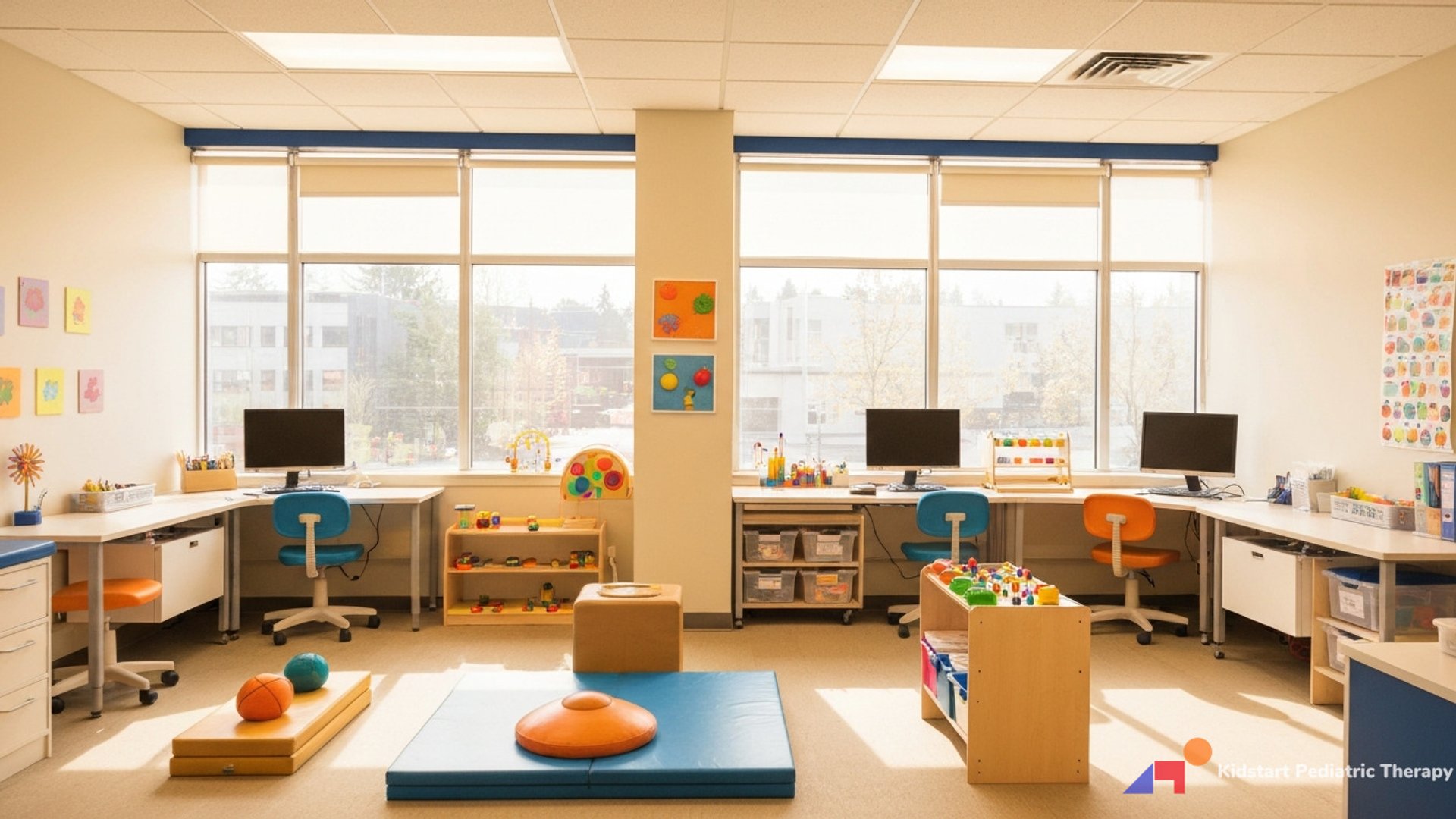
A purpose-built environment. A dedicated sensory gym and child-friendly therapy spaces make a real difference in treatment quality.
A team approach. Clinics that offer OT alongside speech therapy and other services can coordinate your child’s care, reducing the number of appointments and improving outcomes.
Family-centred practice. The best therapists treat parents as partners, offering coaching and home strategies — not just in-clinic sessions. According to the research, 87% of pediatric OT interventions focus on the child as primary client, but the 13% that target parent skills and knowledge are equally important for long-term success (Novak and Honan, 2019).
Experience with your child’s specific needs. Whether it’s autism, ADHD, sensory processing, DCD, or developmental delays, relevant experience matters.
At KidStart Pediatric Therapy in Burnaby, our clinic was designed from the ground up to support pediatric therapy. Our team brings deep experience across the full spectrum of childhood developmental needs.
What Do Other Parents Say About Starting Pediatric OT?
One of the most common things we hear from parents after their first few months at KidStart is some version of: “I wish I’d done this sooner.”
And that tracks with what we see in the data. StatsCan’s Survey on Early Learning and Child Care found that approximately 40% of children were identified as having a long-term condition or disability by at least one measure — yet many of these children weren’t receiving targeted support (Statistics Canada, 2024).
The gap between needing help and getting help is real. Parents often wait because they’re hoping their child will “grow out of it,” or because they’re unsure if the concerns are significant enough. Here’s what we tell those families: an assessment isn’t a commitment to years of therapy. It’s a conversation. It gives you information, options, and a clear picture of where your child is developmentally.
If therapy is recommended, you’ll know exactly why. If your child is developing typically, you’ll have peace of mind. Either way, you’ll be making an informed decision.
Do You Need a Referral to Start Pediatric OT in BC?
No. In British Columbia, you do not need a physician’s referral to access private pediatric occupational therapy. You can contact us directly to book an intake assessment.
That said, some funding sources and extended health plans may require a referral for reimbursement, so check with your provider.
What Age Is Best to Start Pediatric Occupational Therapy?
There’s no single “right” age — the best time to start is when concerns arise. Pediatric OT can benefit:
- Infants and toddlers (0-3) with early motor or feeding delays
- Preschoolers (3-5) with sensory, social, or self-care challenges
- School-age children (5-12) with handwriting, attention, or regulation difficulties
- Adolescents (12+) with executive functioning, life skills, or social challenges
Early intervention consistently produces the strongest outcomes. Canada’s Framework for Autism emphasizes that earlier identification and access to support services leads to better developmental results (Government of Canada, 2024).
What's the Difference Between a Pediatric OT and a COTA?
When you compare pediatric therapy providers, you may see two different credentials. It helps to know what each one means.
A Registered Occupational Therapist (OT Reg. BC) completes a master's-level degree in occupational therapy and is registered with the College of Occupational Therapists of British Columbia (COTBC). A registered OT can assess your child, interpret the results, and design the therapy plan.
A Certified Occupational Therapy Assistant (COTA) works under the supervision of a registered OT. A COTA delivers therapy programs the OT has designed, but cannot independently assess a child or write the plan.
Both roles matter in good pediatric care. The point parents should hold onto is simple: your child's assessment and therapy plan must be designed and supervised by a registered OT. At KidStart, every therapist meets BC registration requirements, is credentialed with COTBC, and is fully insured.
What's the Difference Between School-Based OT and Private Pediatric OT?
This question comes up in almost every intake conversation, so here is the honest answer.
School-based OT in BC is funded through the Ministry of Education, and its scope is deliberately narrow: can this child access the curriculum? A school OT might help a student with pencil grip so they can finish written work, or suggest seating for a child with sensory needs. The focus is school participation — not the whole child.
Private pediatric OT has a broader scope. It addresses the whole child — the sensory system, motor development, self-regulation at home, and daily living skills across every environment. School-based OT can't reach what happens at the dinner table, during bath time, or on the playground at recess. Private OT can.
There is also an access reality. School-based OT services in BC are stretched thin, and many families wait months for an initial school OT consultation — some never get one scheduled. Private OT means faster access, more intensive help, direct family involvement, and progress reports you can share with your school, pediatrician, and funding bodies.
For most families, private pediatric OT is not a replacement for school supports. It is what makes those school supports actually work.
If you’ve been thinking about it, the right time is now.
Frequently Asked Questions About Pediatric OT
Is pediatric OT just for kids with autism?
Not at all. While autism is one of the most common reasons families seek OT — and 24% of pediatric OT research focuses on ASD — occupational therapy helps children with ADHD, sensory processing difficulties, developmental coordination disorder, learning disabilities, anxiety-related challenges, feeding difficulties, and more. Many children benefit from OT without any formal diagnosis.
How is pediatric OT different from physical therapy?
Physical therapy (PT) primarily addresses gross motor skills, strength, and mobility — think walking, running, and balance. Occupational therapy focuses on the skills needed for daily living: fine motor coordination, sensory processing, self-care, emotional regulation, and functional participation at home and school.
Can occupational therapy help with my child’s picky eating?
Yes. OTs with training in feeding and oral motor skills help children expand their food repertoire, improve chewing and swallowing, and reduce anxiety around mealtimes. Picky eating is often connected to underlying sensory processing differences. Our team at KidStart includes therapists with specialized feeding experience.
How often will my child need OT sessions?
Session frequency depends on your child’s needs and goals. Most children attend one to two sessions per week, though this is determined during the initial assessment and adjusted over time. Consistency matters more than intensity — regular weekly sessions combined with home practice typically produce the best results.
What can I do at home to support my child’s OT progress?
Your therapist will provide specific home strategies tailored to your child’s goals. Common recommendations include sensory diet activities, fine motor practice woven into daily routines, visual schedules for transitions, and heavy work activities before challenging tasks. At KidStart, parent coaching is built into every treatment plan because what happens at home matters just as much as what happens in the clinic.
Your Next Step
If you’ve been wondering whether pediatric OT could help your child, the best thing you can do is start the conversation. An intake assessment gives you clarity — where your child is developmentally, what support would benefit them most, and what a realistic path forward looks like.
You don’t need a referral. You don’t need a diagnosis. You just need to reach out.
Contact KidStart Pediatric Therapy or call 604-336-6885 to book an intake assessment at our Burnaby clinic. We proudly serve families across Burnaby, Coquitlam, New Westminster, and Greater Vancouver.
Your child has everything they need to thrive. Sometimes they just need the right support to get there.
KidStart Pediatric Therapy is a team of registered occupational therapists and speech-language pathologists in Burnaby, BC. We specialize in sensory processing, fine motor development, feeding therapy, speech and language development, and autism support for children and families across Greater Vancouver. Learn more about our team.