- Signs your child may need a referral include limited vocabulary for their age, unclear speech at age 3+, or difficulty following two-step directions.
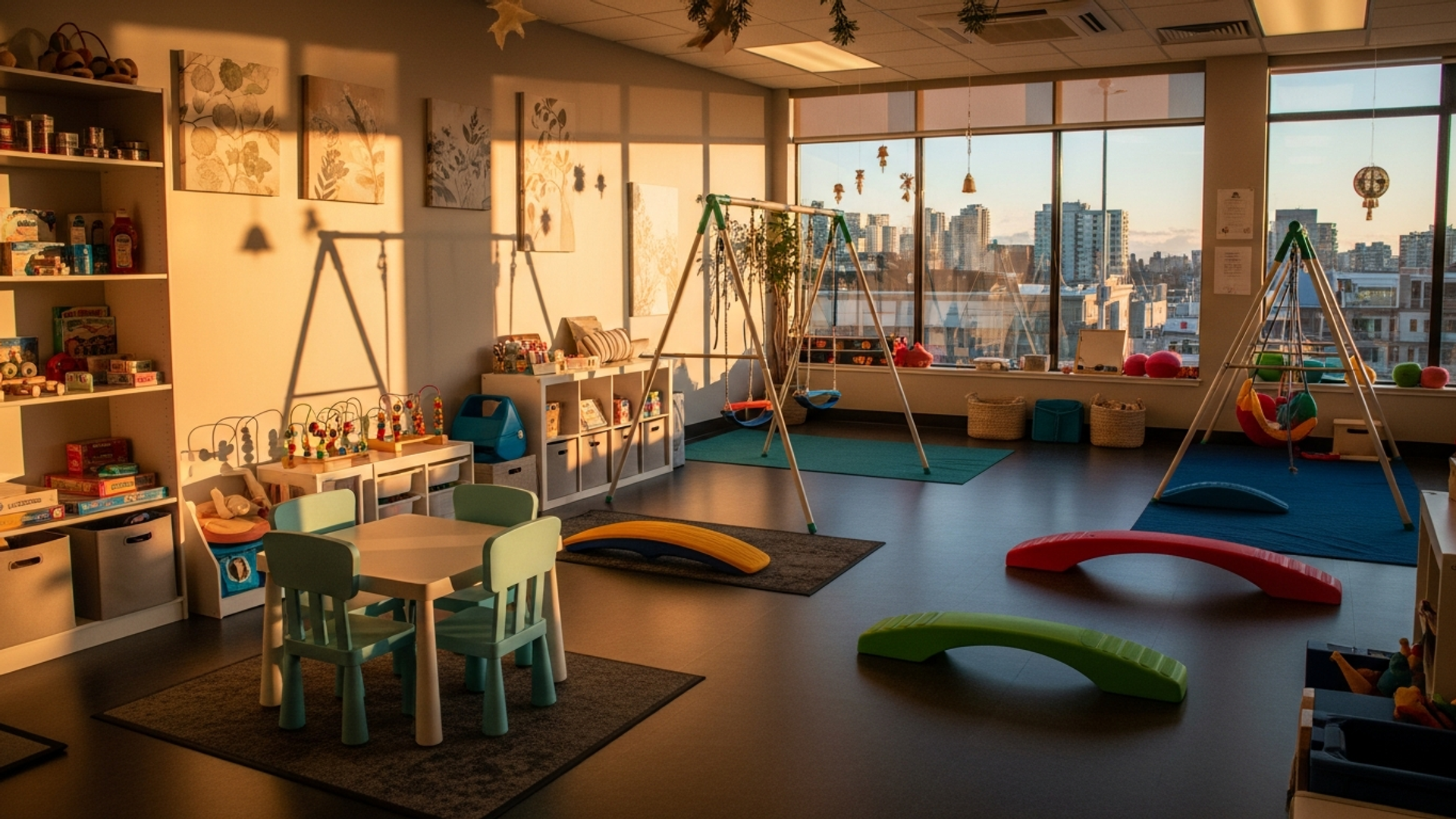
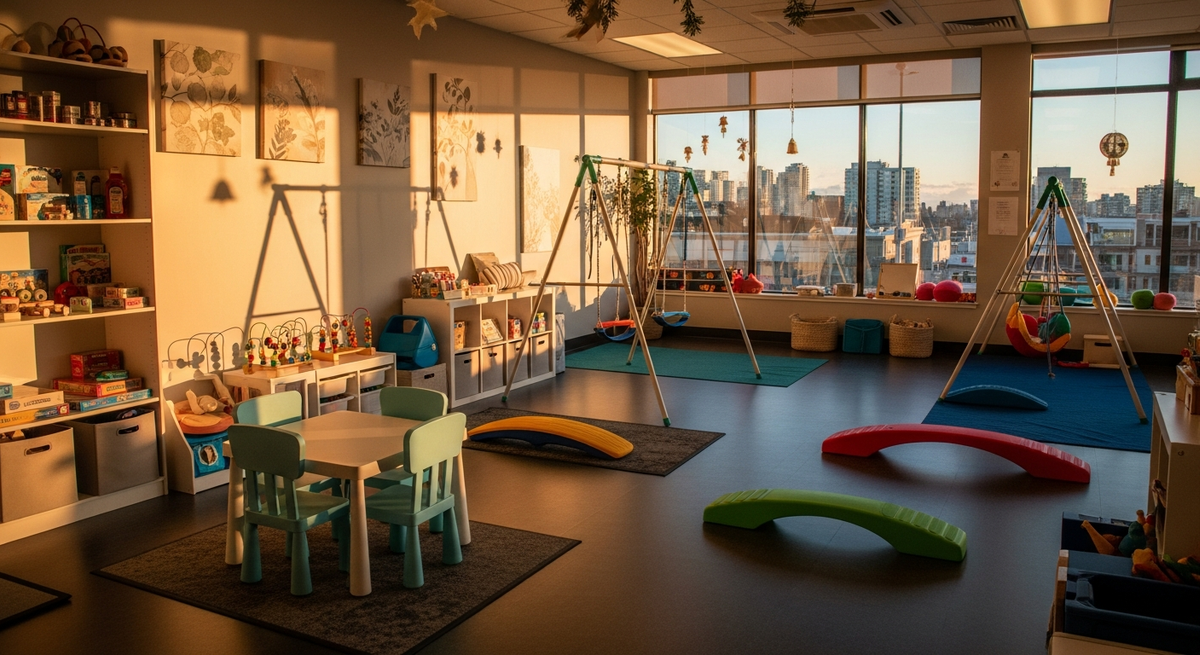
- KidStart's pediatric SLP team in Burnaby works alongside occupational therapists and behavioural therapists — giving your child coordinated support under one roof.
Pediatric speech-language pathologists help children communicate, and getting concerns checked early gives families more options.
But what does a pediatric SLP actually do? How do you know if your child needs one? And how do families in Greater Vancouver access these services without breaking the bank?
This guide answers the questions parents ask most.
What Exactly Is a Pediatric SLP?
A pediatric SLP is a speech-language pathologist who specializes in children. In British Columbia, every practising SLP must be registered with the College of Health and Care Professionals of BC (CHCPBC), which took over from the former College of Speech and Hearing Health Professionals of BC in June 2024. That registration is not optional, and you can check any SLP on the college's public registry.
What most parents don't realize on that first call is how wide the scope actually is. Yes, our SLPs work on speech sounds — the child who says "wabbit" instead of "rabbit" at age five. They help kids who stutter. But the children we see at KidStart also come to us for:
- Language delays: when a child understands less, or says fewer words, than expected for their age. For example, the CDC lists saying about 50 words as a milestone by 30 months.
- Social communication — taking turns in conversation, reading facial expressions, understanding sarcasm. These skills don't develop in isolation; they need coaching and practice with someone who knows what to look for.
- Literacy: the connection between spoken language and reading. A strong language foundation supports early reading.
- Feeding and swallowing — for children with oral motor difficulties in early infancy and beyond. This is where coordination with our OT team becomes critical.
- Augmentative and alternative communication (AAC) — devices and tools that help non-verbal or minimally verbal children express themselves. A child who can't speak can still communicate, and AAC opens that door.
Speech-Language & Audiology Canada (SAC) says 1 in 6 people has a speech, language or hearing disorder. In children, many of these difficulties show up early.
What Signs Tell You Your Child Might Need a Pediatric SLP?
Every parent who calls KidStart asks this question: "Is this just a phase?"
Developmental milestones are guides, not rigid checklists. Here's what to watch for.
At 12–18 months:
- Not saying "mama," "dada," or at least one other word
- Not pointing to objects or responding to their name consistently
- Not waving goodbye or imitating simple sounds
An 18-month-old who isn't using any words is worth checking with your doctor or an SLP.
At 2–3 years:
- Fewer than 50 words at 24 months
- Not saying about 50 words by 30 months (a CDC milestone)
- Speech that even familiar adults find very hard to understand
This is a window where regular therapy and practice at home can make a real difference.
At 4–5 years:
- Leaving out beginning or ending sounds in words
- Difficulty retelling a simple story in sequence
- Struggles to follow two-step directions ("Get your shoes and come here")
At any age:
- A sudden loss of words or language skills previously gained — this always warrants immediate evaluation
- Visible frustration when trying to communicate. A child who knows what they want to say but can't say it is a child in distress.
- Avoiding speaking in group or social settings. Selective mutism or social anxiety around communication deserves professional assessment.
The US National Institute on Deafness and Other Communication Disorders reports that by first grade, roughly 5% of children have noticeable speech disorders.
Don't wait. If you're seeing these signs, request a referral. An early assessment gives you answers sooner.
What Does a Pediatric SLP Assessment Actually Involve?
Parents dread the word "assessment." They picture their child sitting through hours of rigid testing in a clinical room with a stranger holding a clipboard.
A good assessment doesn't look like that.
The first session is usually an intake. The SLP talks with you about your concerns, your child's history and what you notice at home. Your observations are important information.
Then comes the formal assessment. Depending on your child's age and what brings you to us, it includes:
- Standardized tests — tools like the *Preschool Language Scales (PLS-5)* or *Clinical Evaluation of Language Fundamentals (CELF)* that compare your child to same-age peers.
- Informal observation — our SLP watches how your child plays, initiates, and responds in natural situations. This is where we see the real child, not the child performing for a test.
- Parent questionnaires — structured ratings across home, daycare, and social settings. Communication doesn't happen in one room; it happens everywhere.
After the assessment, you receive a written report from your SLP. It explains where your child's skills fall relative to age expectations. It includes specific, measurable goals. And it outlines a therapy plan with recommended frequency and duration.
Many parents find the assessment a relief because it puts words to what they've been noticing. That shift from uncertainty to action is where progress begins.
How Long Does Pediatric Speech Therapy Take?
This depends on three factors: the nature of the challenge, the child's age, and how consistently you practice at home.
A child working on one or two speech sounds usually needs less time than a child with a broader language delay or complex communication needs. Your SLP will suggest a plan after the assessment.
Starting early and practising consistently both matter. Your SLP can explain what the research says for your child's specific difficulty.
Most therapy is weekly, sometimes more often when more intensity is needed. Therapy doesn't stop at the clinic door: your SLP should send you home with specific strategies to build into breakfast, bath time and car rides. Parent involvement is a key part of progress.
Can BC Autism Funding Cover Pediatric SLP Services?
Yes — and this changes the math for many Burnaby and Coquitlam families.
In British Columbia, children with an autism diagnosis may qualify for Autism Funding through the Ministry of Children and Family Development (MCFD), and it can pay for eligible SLP services. KidStart's autism funding page says it accepts BC government funding.
The Public Health Agency of Canada reported in 2022 that 1 in 50 Canadian children and youth aged 1 to 17 had an autism diagnosis. Many autistic children also have communication challenges.
BC's autism funding program offers two streams:
- Autism Funding: Under 6 — up to $22,000 per year for children under 6 with an ASD diagnosis
- Autism Funding: Ages 6–18 — up to $6,000 per year for children 6 to 18 with an ASD diagnosis
- Both streams end on March 31, 2027, when a needs-based BC Children and Youth Disability Benefit begins.
Families choose eligible providers and send MCFD a Request to Pay form, and the Autism Funding Unit pays the provider's invoice from the child's account.
Want to know how to access these funds, what documentation you need, and how to use them for SLP services? Visit our detailed autism funding guide for a step-by-step breakdown.
What's the Difference Between a Pediatric SLP and a School-Based Speech Therapist?
Both work with children's communication. The scope is different — and the outcomes reflect it.
School-based SLPs work within BC's public school system, and their focus is helping your child take part in classroom learning. Caseloads, session frequency and wait times vary by district, so ask your school what support is available.
Private pediatric SLPs can set goals with your family around your child's whole day, not just school.
Coordination matters. When an SLP works with a child's other therapists, goals and strategies can line up.
At KidStart, our SLPs work in the same building as our occupational therapists and behavioral therapy team. When clinicians share what they see, a strategy that works in one session can be used in the others.
How Does Play-Based Speech Therapy Work for Young Children?
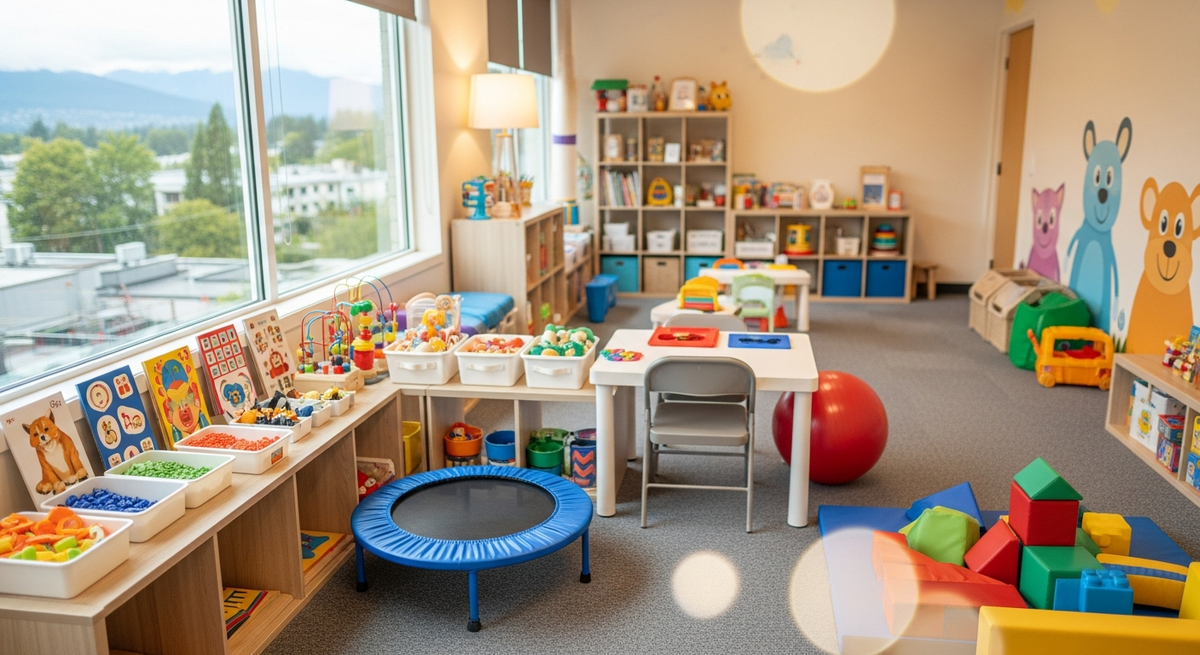
Young children don't learn through worksheets or structured drills. They learn through play. At KidStart, every SLP on our team knows this — and designs every session around your child's actual interests.
For a child obsessed with trains, we use trains. For a child who loves bubbles, bubbles become the language lesson. Using a child's interests keeps them engaged.
A typical play-based SLP session for a 3-year-old with a language delay looks like this:
- Child-led play (10 minutes): Our SLP follows the child's lead. No demands. Just observation and natural commenting ("You're building a tower! Big tower!"). We're watching what interests them, how they play, what they're ready to learn.
- Targeted play (20 minutes): The SLP introduces activities designed to target specific language goals — requesting, naming, sequencing, describing. The child doesn't know they're doing "therapy." They're playing a game designed specifically for their needs.
- Parent coaching (10–15 minutes): The SLP shows you exactly what to do at home. You practice together while they watch. You leave with a real strategy, not just a summary.
Coaching parents to use language strategies during everyday play is a common part of pediatric speech therapy.
Your involvement isn't optional. It's the multiplier on your child's progress.
Is Pediatric SLP Covered by BC Health Insurance?
Private pediatric SLP services are not covered by BC's Medical Services Plan (MSP).
That said, several funding options can reduce or eliminate out-of-pocket costs:
1. BC Autism Funding (MCFD) Children with an ASD diagnosis can access up to $22,000/year (under 6) or $6,000/year (ages 6–18). The program ends on March 31, 2027.
2. Children and Youth with Support Needs (CYSN) services. MCFD offers other supports for children with support needs, so contact MCFD to ask what your child may be eligible for. From April 1, 2027, the needs-based BC Children and Youth Disability Benefit replaces Autism Funding.
3. Extended Health Benefits. Many employer plans include speech-language pathology coverage. Check your plan under paramedical or rehabilitation services for the yearly limit.
4. School-Based Services. Ask your school district what speech-language support is available. School services can complement private therapy.
Visit our services page to learn more about what KidStart offers and how our team supports you in coordinating funding.
What Other Therapies Work Alongside Pediatric SLP?
Speech and communication don't exist in isolation. A child who struggles with sensory regulation can't focus long enough to learn new language. A child with anxiety about social interaction may freeze when asked to speak.
That is why coordinated care helps: one child, one team, one goal plan.
Occupational Therapy (OT) OTs address sensory processing, fine motor development, and self-regulation. When a child can manage their nervous system, they're more available for communication. OT and SLP goals often overlap, so it helps when both clinicians share a goal plan. An OT who knows the child is working on turn-taking in speech can reinforce it during fine motor activities.
Behavioural Therapy Applied Behaviour Analysis (ABA) uses structured teaching to build communication and social skills. It's evidence-based for children with ASD. It complements SLP work directly — especially for children who need consistent structure to generalize new skills across settings.
The TILP Program: KidStart's Therapeutic Intensive Learning Program (TILP) combines occupational therapy, speech therapy and BCBA-supervised behavioural consultation for about 10.5 hours a week, for children ages 3 to 6.
Explore all our services to see how we structure coordinated care for each child.
What Should You Ask Before Choosing a Pediatric SLP?
Not all SLP clinics are equal. Here are five questions worth asking before you book — questions we're happy to answer at KidStart.
1. Is the SLP registered with CHCPBC? In BC, registration with the College of Health and Care Professionals of BC is required to practise speech-language pathology, and you can check any SLP on the college's public registry.
2. What's your experience with my child's specific needs? An SLP who specializes in toddler language delay is different from one who focuses on school-age literacy. Ask specifically about their experience with your child's profile — whether that's autism, selective mutism, stuttering, or AAC.
3. Do you offer parent coaching as part of every session? If the answer is "sometimes" or "as needed," probe further. Consistent parent coaching is one of the strongest predictors of outcome. It should be standard, not optional.
4. How will you coordinate with my child's other providers? Cross-disciplinary communication should be routine. Ask how the SLP shares updates with the OT, the pediatrician, and the school team. Ask if they use a shared care plan.
5. What does your current wait time look like? Wait times vary by clinic. Start your search before the need becomes urgent. Ask KidStart about current availability through its contact page.
FAQ
What is a pediatric SLP and what do they treat? A pediatric SLP is a registered speech-language pathologist who specializes in children's communication development. They assess and treat speech sound disorders, language delays, stuttering, social communication challenges, literacy-language connections, feeding difficulties, and AAC needs. In BC, every practicing SLP must hold registration with the College of Health and Care Professionals of BC (CHCPBC). The scope is far broader than most parents realize when they first make a referral.
At what age should my child see a pediatric SLP? There is no minimum age. Pediatric SLPs work with infants as young as a few months old — for feeding difficulties — through to adolescents. For speech and language concerns, earlier is almost always better. If you are worried about your toddler's words, that is reason enough to ask. Don't wait for the next milestone. KidStart offers a free consultation.
How is a private pediatric SLP different from the school speech therapist? The clinical credential is the same. The scope and intensity are different. School-based SLPs carry large caseloads and focus on academic access. Private SLPs like the team at KidStart work on your child's full communication profile — with direct parent coaching and coordination with your child's other therapists.
Does BC autism funding cover pediatric SLP? Yes. BC's Autism Funding Program through MCFD can be directed toward SLP services from eligible providers. Children under 6 with an ASD diagnosis can access up to $22,000 annually. Children 6–18 can access up to $6,000 annually, until the program ends on March 31, 2027. KidStart's autism funding page explains how it accepts BC government funding. For eligibility criteria and how to apply, see our autism funding page.
What should I expect at my child's first pediatric SLP appointment? The first session is typically an intake — not a full assessment. Your SLP will ask about your child's developmental history, your specific concerns, and what you observe at home. They may do some informal play-based observation. Full standardized assessment happens in a follow-up session. You'll leave the first appointment with clear next steps and a solid understanding of what the process involves — and whether our clinic is the right fit for your family.
Book Your Intake Assessment at KidStart
Your child's communication starts developing long before school. The window for early intervention is real — and it's open right now.
KidStart Pediatric Therapy serves families across Burnaby, Coquitlam, and Greater Vancouver. Our pediatric SLP team works directly with our occupational therapists and behavioural support staff — so your child gets coordinated care under one roof, not a fragmented service spread across providers.
Contact us at kidstartpediatrictherapy.com or call 604-336-6885 to book your intake assessment. We're ready when you are.