Parents searching for pediatric physiotherapy near me in Burnaby and Greater Vancouver are often doing so at 11pm, heart pounding, after months of watching their child struggle with something that doesn't have a name yet.
Maybe it's your four-year-old who trips constantly. Falls when other kids his age run without a second thought. Or your seven-year-old who complains her hands hurt when she writes, who avoids the playground because the sensory chaos of it overwhelms her in ways she can't explain. You've mentioned it to the pediatrician. You've Googled. You've watched YouTube videos. And still — you're not sure what your child needs, or where to go, or whether you're overreacting.
You're not overreacting.
And the answer is usually not one thing. It's a team.
Pediatric physiotherapy focuses on a child's movement, strength, balance and coordination, and in BC physiotherapists must be registered with the College of Health and Care Professionals of BC (CHCPBC). KidStart Pediatric Therapy does not list physiotherapy among its services. It offers occupational therapy, speech therapy and behaviour consultation, which often work alongside a child's physiotherapist. Children under 6 with an autism diagnosis may use BC Autism Funding for eligible therapy, including from physical therapists listed on the Registry of Autism Service Providers, until March 31, 2027.
What Is Pediatric Physiotherapy and Is It the Same as Adult Physio?
Here's the thing most parents don't realize: pediatric physiotherapy is its own world. It's not just adult physiotherapy scaled down for smaller bodies.
Children's nervous systems are still forming. Their bones are growing. Their motor patterns are being laid down for the first time — not re-learned after an injury like in adult rehab. A pediatric physiotherapist understands that window of neuroplasticity and knows how to work inside it.
Pediatric physiotherapy targets a range of conditions including:
- Gross motor delays (running, jumping, climbing, balance)
- Coordination difficulties — sometimes called Developmental Coordination Disorder (DCD)
- Hypotonia, or low muscle tone
- Torticollis and plagiocephaly in infants
- Gait abnormalities (toe walking, in-toeing, out-toeing)
- Post-surgical rehabilitation
- Neurological conditions including cerebral palsy and spina bifida
- Sports injuries in older children
- Conditions co-occurring with autism, ADHD, or sensory processing disorder
Developmental concerns are common. In the United States, CDC researchers estimated that about 1 in 6 children aged 3 to 17 had one or more developmental disabilities in 2015 to 2017.
Why Do So Many Children With Autism or ADHD Need Physiotherapy?
This surprises parents. They come in thinking their child needs speech therapy — or behavioral support — and they're right. But they didn't expect the physiotherapy conversation.
Here's why it matters so much.
Many autistic children also have motor challenges. In a 2020 SPARK study in the journal Physical Therapy, parent questionnaires showed that 86.9% of 11,814 autistic children aged 5 to 15 were at risk for motor impairment, yet only 31.6% were receiving physical therapy (Bhat, 2020). Motor difficulties can affect social play, handwriting, sport and confidence.
Children with ADHD can have coordination difficulties too. A child who struggles physically may avoid active play, which then limits practice.
A child who comes in for speech or behaviour concerns may also have low muscle tone, avoid climbing, or tire quickly. That physical picture is part of the story, and it is worth raising with your child's team.
KidStart's team provides occupational therapy, speech therapy and behaviour consultation. It does not list physiotherapy as a service, so families who need physiotherapy work with a registered physiotherapist elsewhere and can ask both teams to share goals.
You can learn more about KidStart's services on the services page.
What Happens During a Pediatric Physiotherapy Assessment?
Let's walk through it. Because not knowing what to expect is one of the biggest reasons parents delay.
The first appointment is an intake assessment. Don't think of it as a test your child could fail. Think of it as a detailed map-making session.
The therapist will:
1. Talk with you — about your child's history, birth, developmental milestones, what you've noticed at home, what teachers have said, what worries you most. 2. Observe your child in movement — how they walk, run, jump, balance on one foot, climb, reach, carry objects. 3. Use standardized assessments — tools like the Bruininks-Oseretsky Test of Motor Proficiency (BOT-2) or the Movement Assessment Battery for Children (MABC-2) to benchmark your child's motor skills against age-expected norms. 4. Identify the gap — where your child is versus where they should be, and what's contributing to that gap. 5. Discuss a plan — frequency of sessions, goals, what home practice looks like, how success is measured.
Nothing about this needs to be scary. Good pediatric therapists are trained to make children feel safe. Play is the medium. The therapy looks like fun — to the child. The parent sees the work underneath.
How Do I Know If My Child Needs Physiotherapy, Occupational Therapy, or Both?
Parents ask this often.
Here's the honest answer: the line between pediatric physiotherapy and pediatric occupational therapy is blurry — and that's actually fine.
Put it this way:
Physiotherapy tends to focus on the big movements. Walking. Running. Strength. Endurance. Structural alignment. Gross motor skill development.
Occupational therapy tends to focus on the functional tasks of daily life — dressing, eating, writing, play, sensory regulation, fine motor skills, self-care routines.
But here's the truth: a child who can't hold a pencil properly might have a fine motor issue (OT territory), but it might also trace back to poor core stability and shoulder girdle weakness (physio territory). A child who can't participate in gym class might need gross motor work (physio) but also sensory processing support (OT).
The best outcomes happen when both disciplines communicate — or when your child is seen by a team that already operates that way.
When several therapists are involved, ask them to share goals and updates so your child gets one consistent plan.
KidStart's TILP (Therapeutic Intensive Learning Program) combines occupational therapy, speech therapy and BCBA-supervised behavioural consultation for children ages 3 to 6.
Does BC Government Autism Funding Cover Pediatric Physiotherapy?
It can, for children with an autism diagnosis.
BC's Autism Funding program pays for eligible services for children with an autism diagnosis: up to $22,000 per year for children under 6 and up to $6,000 per year for ages 6 to 18. The program ends on March 31, 2027, when a needs-based BC Children and Youth Disability Benefit begins.
The Registry of Autism Service Providers (RASP), used with Autism Funding, lists physical therapists as well as occupational therapists, speech-language pathologists and behaviour consultants.
KidStart's autism funding page explains how it works with provincial funding for its own services.
Get the full picture on KidStart's autism funding page.
What Should I Look for When Choosing a Pediatric Therapy Clinic Near Me?
Not all clinics are the same. Here's how to tell the difference between a clinic that's genuinely equipped for your child — and one that isn't.
1. Specialized Pediatric Training
In BC, physiotherapists are regulated by the College of Health and Care Professionals of BC, which took over from the former College of Physical Therapists of BC in June 2024. But licensure alone doesn't mean pediatric specialization. Ask directly: what percentage of their caseload is children? What additional pediatric training have they completed? Are they familiar with neurodevelopmental approaches?
2. A Sensory-Informed Environment
If your child has sensory processing differences — and many children who need physiotherapy do — the clinic environment itself matters. Harsh lighting, loud acoustics, a waiting room full of chaos. These things tank a child's ability to participate in therapy before the session even starts.
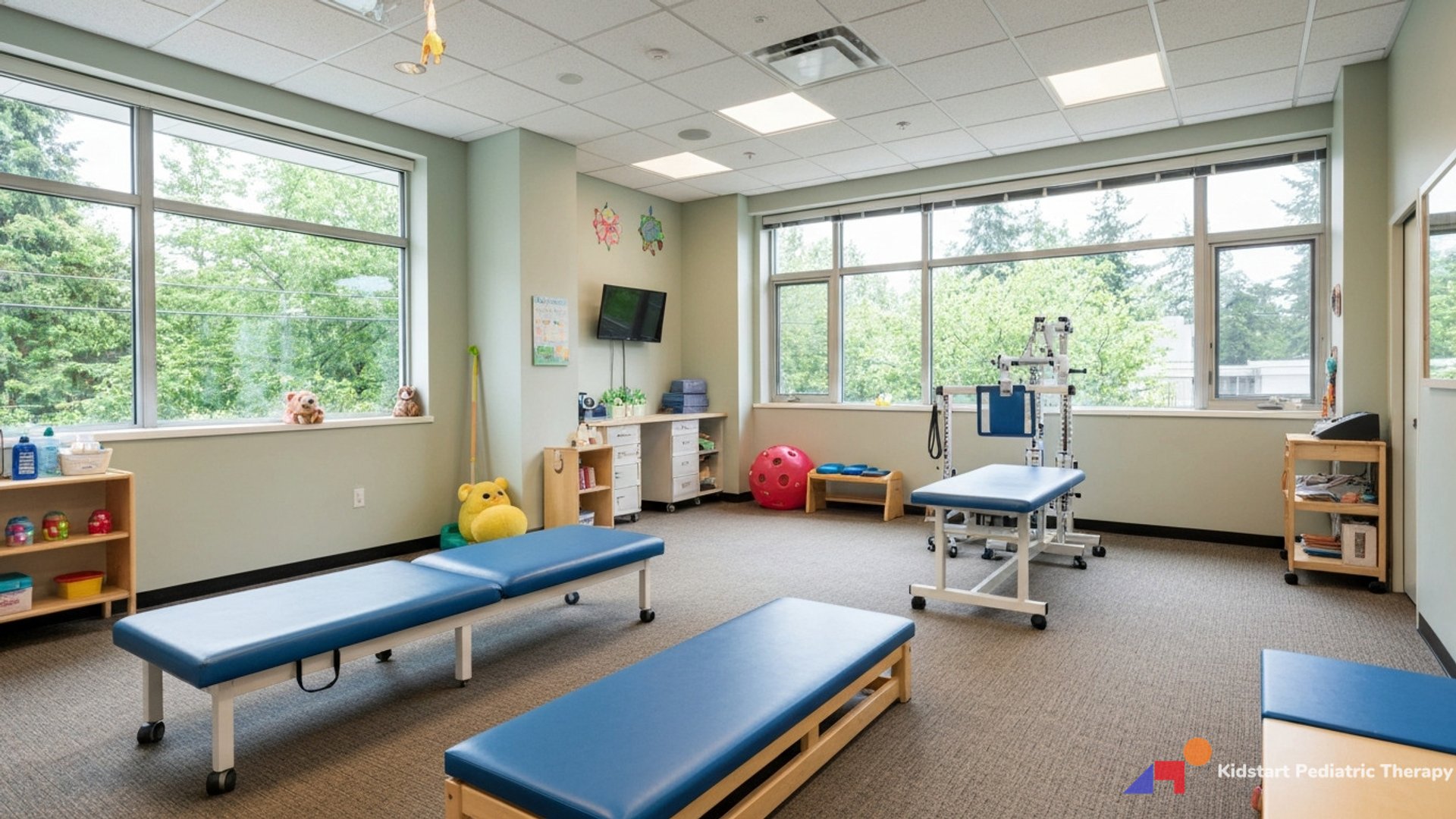
KidStart's facility in Burnaby includes a dedicated sensory gym — a therapeutic space designed specifically for sensory-informed work. It's not a gimmick. It's a tool.
3. Collaborative Team Communication
Ask how the therapists at the clinic communicate with each other. Is there a shared file system? Regular case conferences? Does the physio know what the OT is working on? Do they write joint reports for school teams?
Progress is easier when every therapist knows what the others are working on.
4. Parent Coaching as Part of the Program
This is non-negotiable. Therapy happens one, maybe two hours a week. The other 166 hours — your child is at home, at school, in the community. The skills built in therapy only transfer if they're practiced. A good clinic teaches *you* to be the carry-through agent. That's not extra. That's the point.
5. Waitlist Transparency
Be direct and ask about wait times. Public and private wait lists vary, so ask each clinic for its current estimate.
What's the Difference Between a TILP Program and Standard Therapy Sessions?
Most therapy is reactive. A child shows up. A therapist works with them for 45 minutes. They go home. Next week, repeat.
At KidStart, TILP stands for Therapeutic Intensive Learning Program. It combines occupational therapy, speech therapy and BCBA-supervised behavioural consultation for about 10.5 hours a week, for children ages 3 to 6.
Think of it like this: weekly sessions give you appointments; an intensive program gives you coordinated time across several therapies.
Because the three disciplines work together, a child's goals are coordinated across therapy types rather than set separately.
For children with complex needs, such as autism, ADHD, sensory processing differences or developmental delays, coordinated planning can make therapy easier to carry over at home.
Learn more about behaviour consultation and intervention at KidStart.
How Early Is Too Early to Start Pediatric Physiotherapy?
If you have concerns, earlier is usually better.
Early childhood is a period of rapid growth and motor development, so it makes sense to get concerns checked early rather than wait.
Parents are often told to wait and see. Sometimes children do catch up, but if something feels off, an assessment gives you answers sooner.
If something feels off, trust your instinct. Get the assessment. The worst case scenario is you learn your child is developing typically and you go home with peace of mind. The best case scenario — you catch something early and the trajectory of your child's development changes.
What Are the Signs That My Child Might Benefit From Physiotherapy Right Now?
Here's a direct checklist. If your child shows three or more of these consistently, book an assessment:
- Falls significantly more than other children the same age
- Avoids climbing, jumping, or running
- Tires easily during physical activity compared to peers
- Walks on toes (past age 2–3)
- Has flat feet with pain or significant in-toeing
- Shows low muscle tone — feels "floppy," has difficulty holding their head up or maintaining seated posture
- Struggles with ball skills — catching, throwing, kicking — well beyond typical development
- Has delayed motor milestones (crawling, walking, running)
- Complains of frequent leg or foot pain
- Has difficulty with transitions between positions (floor to standing, sitting to kneeling)
- Is unusually clumsy — bumping into things, misjudging distances
- Has a diagnosis of autism, ADHD, or DCD and hasn't yet had a physiotherapy assessment
Who Does KidStart Serve and Where Are We Located?
KidStart Pediatric Therapy is based in Burnaby, BC, and serves families across Burnaby, Coquitlam, New Westminster, Port Moody, Vancouver, and the broader Greater Vancouver region.
KidStart's team includes occupational therapists, speech-language pathologists, behaviour consultants and interventionists led by a Board Certified Behavior Analyst, and a registered clinical counsellor. It does not list physiotherapy among its services.
KidStart focuses on children and families, with an on-site sensory gym and the TILP program.
Families using BC Autism Funding can ask the KidStart team how funding applies to its services.
FAQ: Pediatric Physiotherapy Near Me — What Parents Ask Most
1. How long does it take to see results from pediatric physiotherapy?
It depends on the child, the condition and how often therapy happens. Your physiotherapist should set measurable goals at the start so you can see progress, even when it feels slow.
2. Can my child do physiotherapy and occupational therapy at the same time?
Absolutely — and for many children with autism, ADHD, or sensory processing challenges, doing both at the same time is common. The two disciplines complement each other significantly. Ask your physiotherapist and occupational therapist to share goals so their work supports each other.
3. Do I need a doctor's referral to book pediatric physiotherapy in BC?
Ask the clinic whether it needs a referral. Some insurance plans require a doctor's referral for coverage, so check your plan documents. If you are using BC Autism Funding, ask the provider whether they are on the Registry of Autism Service Providers.
4. What if my child refuses to cooperate in sessions?
This is common, especially early on. Children who've had difficult experiences in medical or clinical settings often need time to trust a new environment and a new person. Skilled pediatric therapists are trained in exactly this situation. Sessions are play-based. Therapists follow the child's lead. Pressure is kept low. Many children warm up once they feel safe and the activities feel like play.
5. Is KidStart Pediatric Therapy the right fit if my child doesn't have a formal diagnosis yet?
Yes. A formal diagnosis is not required to access therapy at KidStart. Many families come to us in the middle of the diagnostic process — or before it's started — because they've noticed something and want to act. We assess the child in front of us, not the label. If your child has functional challenges — in movement, communication, behavior, or daily skills — we build a plan around those challenges, diagnosis or no diagnosis.
Ready to Stop Searching and Start Acting?
Every week you wait is a week your child isn't getting the support they need. That's not a guilt trip — it's just the truth. And the truth is also this: it's not too late, and you found this article for a reason.
KidStart Pediatric Therapy is in Burnaby, BC, and we serve families across Coquitlam and Greater Vancouver who are exactly where you are right now — asking the right questions, looking for the right team, ready to move.
Contact KidStart Pediatric Therapy through the contact page or call 604-336-6885 to book an intake assessment. The team will listen, assess, and give you a clear picture of what your child needs and what a realistic plan looks like.
You don't have to figure this out alone. We do this every day — and we'd be glad to do it for your family.
Related: counselling for kids in Surrey